Last Updated: 01 June, 2026
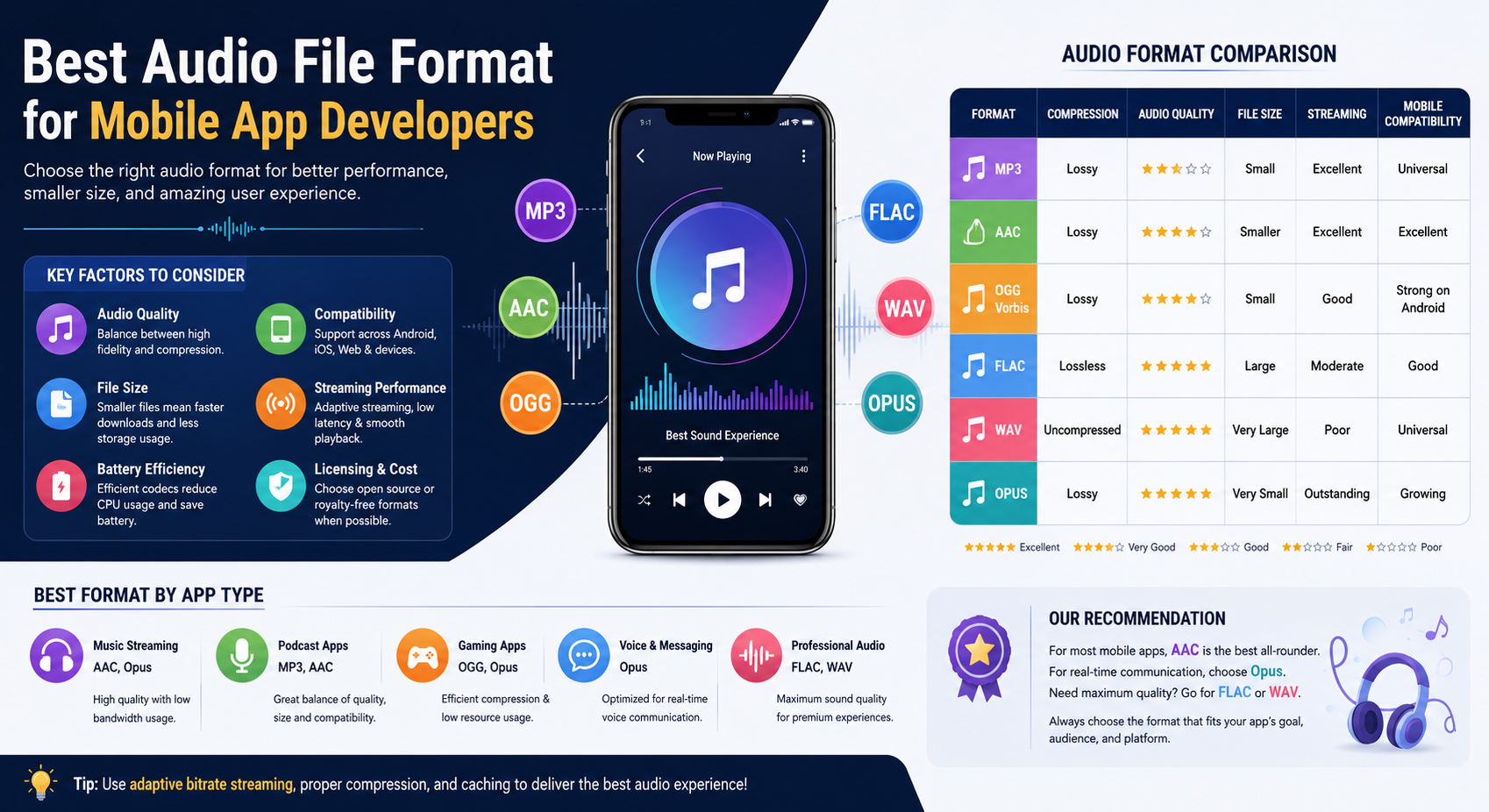
Best Audio File Format for Mobile App Developers in 2026
Mobile apps are becoming more media-driven than ever before. From music streaming and podcast apps to gaming, social media, messaging, e-learning, and video platforms, audio plays a major role in delivering engaging user experiences. However, choosing the right audio file format is not as simple as selecting the most popular option.
For mobile app developers, the ideal audio format depends on multiple factors such as file size, audio quality, streaming performance, device compatibility, licensing, and battery efficiency. A poor format choice can increase app size, slow streaming, reduce audio quality, or create compatibility issues across Android and iOS devices. In this guide, we will explore the best audio file formats for mobile app development, compare their strengths and weaknesses, and help developers select the right format for their projects in 2026.
Why Audio File Format Matters in Mobile Apps
Audio files directly impact app performance and user experience. Developers must balance several technical considerations:
- Storage optimization
- Streaming efficiency
- Bandwidth consumption
- Audio quality
- CPU and battery usage
- Cross-platform compatibility
- Licensing costs
For example, a high-quality uncompressed audio file may sound excellent but can dramatically increase app size and loading times. On the other hand, highly compressed formats may reduce quality but improve streaming speed and storage efficiency. Selecting the correct format ensures better scalability, smoother playback, and improved user retention.
Key Factors Developers Should Consider
Before choosing an audio format, mobile developers should evaluate the following factors.
1. Audio Quality
Different formats use different compression methods. Some formats preserve original sound quality, while others sacrifice quality to reduce file size.
Types of Compression
Lossless Compression
- Preserves original audio quality
- Larger file sizes
- Better for editing and professional audio
Lossy Compression
- Removes some audio data
- Much smaller files
- Ideal for streaming and mobile apps
2. File Size
Smaller files improve:
- Faster downloads
- Reduced bandwidth usage
- Lower app storage requirements
- Better streaming performance
This is especially important for users with limited mobile data or lower-end devices.
3. Platform Compatibility
The chosen format should work smoothly on:
- Android
- iOS
- Web apps
- Smart TVs
- Wearables
Not all audio formats are universally supported.
4. Streaming Performance
Streaming apps require formats optimized for:
- Adaptive bitrate streaming
- Fast buffering
- Low latency
- Network optimization
5. Licensing and Patents
Some audio codecs involve licensing fees, while others are open source and royalty-free. This can significantly impact commercial app development costs.
Best Audio File Formats for Mobile App Developers
Let’s examine the most important audio formats used in modern mobile apps.
MP3 – The Universal Standard
What is MP3?
MP3 remains one of the most widely supported audio formats in the world. It uses lossy compression to significantly reduce file size while maintaining acceptable sound quality.
Advantages
- Universal compatibility
- Small file sizes
- Fast streaming
- Easy implementation
- Supported by nearly all devices
Disadvantages
- Lower audio quality compared to newer formats
- Less efficient compression
- Aging technology
Best Use Cases
- Podcasts
- Voice recordings
- Background music
- General-purpose mobile apps
Why Developers Still Use MP3
Despite newer alternatives, MP3 remains popular because it works everywhere without compatibility issues.
AAC – Best Overall Choice for Mobile Apps
What is AAC?
Advanced Audio Coding (AAC) was designed to outperform MP3 while maintaining smaller file sizes and better sound quality.
AAC is heavily used by:
- YouTube
- Apple Music
- iOS ecosystem
- Mobile streaming platforms
Advantages
- Better audio quality than MP3
- More efficient compression
- Excellent iOS support
- Ideal for streaming
- Lower bandwidth usage
Disadvantages
- Slightly more complex encoding
- Patent/licensing considerations
Best Use Cases
- Music streaming apps
- Social media apps
- Video apps
- Real-time audio streaming
Why AAC is Excellent for Mobile Developers
AAC provides one of the best balances between quality and performance. For most modern mobile apps, AAC is often the safest and most efficient option.
OGG Vorbis – The Open Source Alternative
What is OGG Vorbis?
OGG Vorbis is a royalty-free, open-source audio format known for excellent compression efficiency and strong audio quality.
It is widely used in:
- Open-source applications
- Android games
- Indie development
Advantages
- Completely royalty-free
- Better quality than MP3
- Efficient compression
- Good for Android platforms
Disadvantages
- Limited Apple ecosystem support
- Less universal compatibility
Best Use Cases
- Android apps
- Open-source mobile apps
- Mobile games
Why Developers Like OGG
Developers who want to avoid licensing costs often prefer OGG Vorbis.
FLAC – Best for High-Quality Audio
What is FLAC?
FLAC (Free Lossless Audio Codec) preserves original audio quality while reducing file size through lossless compression.
Advantages
- Lossless audio quality
- Open-source format
- Excellent for professional audio
Disadvantages
- Larger file sizes
- Higher storage requirements
- Not ideal for mobile streaming
Best Use Cases
- Audiophile apps
- Music production tools
- Offline premium audio apps
Why FLAC is Limited in Mobile Apps
Although FLAC offers outstanding quality, its larger size makes it less suitable for bandwidth-sensitive applications.
WAV – Raw Audio for Processing
What is WAV?
WAV is an uncompressed audio format commonly used in professional recording and editing.
Advantages
- Highest audio quality
- No compression artifacts
- Excellent for editing
Disadvantages
- Extremely large file sizes
- Poor streaming performance
- High storage usage
Best Use Cases
- Audio editing apps
- Voice analysis systems
- Professional recording tools
Opus – The Future of Mobile Audio
What is Opus?
Opus is a modern open-source codec optimized for internet audio streaming and real-time communication.
It is designed for:
- Voice chat
- Video calls
- Live streaming
- Low-latency applications
Advantages
- Exceptional compression efficiency
- Very low latency
- Excellent voice quality
- Open-source and royalty-free
Disadvantages
- Not as universally supported as MP3
- Some legacy device limitations
Best Use Cases
- Messaging apps
- VoIP applications
- Real-time communication apps
- Gaming voice chat
Why Opus is Growing Rapidly
Opus delivers outstanding performance for modern communication apps and is becoming increasingly important for developers.
| No. | Format | Compression | Audio Quality | File Size | Streaming | Mobile Compatibility |
|---|---|---|---|---|---|---|
| 1 | MP3 | Lossy | Good | Small | Excellent | Universal |
| 2 | AAC | Lossy | Very Good | Smaller than MP3 | Excellent | Excellent |
| 3 | OGG | Lossy | Very Good | Small | Good | Strong on Android |
| 4 | FLAC | Lossless | Excellent | Large | Moderate | Good |
| 5 | WAV | Uncompressed | Excellent | Very Large | Poor | Universal |
| 6 | Opus | Lossy | Excellent | Very Small | Outstanding | Growing |
Best Audio Formats Based on App Type
Music Streaming Apps
Recommended Formats:
- AAC
- Opus
These formats provide excellent streaming quality with low bandwidth usage.
Podcast Applications
Recommended Formats:
- MP3
- AAC
These formats balance compatibility and file size.
Mobile Gaming Apps
Recommended Formats:
- OGG Vorbis
- Opus
Both provide efficient compression and low resource consumption.
Voice Chat and Messaging Apps
Recommended Formats:
- Opus
Opus is optimized for real-time voice communication.
Professional Audio Apps
Recommended Formats:
- FLAC
- WAV
These preserve maximum sound fidelity.
Which Audio Format Should Mobile Developers Choose?
There is no single perfect format for every application.
Here are the best choices for most scenarios:
- Best Overall: AAC
- Best for Voice Apps: Opus
- Best Compatibility: MP3
- Best Open Source Option: OGG Vorbis
- Best Lossless Quality: FLAC
- Best for Editing: WAV
Modern developers often combine multiple formats depending on content type and platform requirements.
Final Thoughts
Audio optimization is a critical part of modern mobile app development. The right audio format can improve streaming performance, reduce storage requirements, lower bandwidth costs, and deliver a better user experience. In 2026, AAC and Opus are leading choices for most mobile applications because they provide excellent compression efficiency, strong audio quality, and optimized mobile performance. However, MP3 still remains valuable for compatibility, while FLAC and WAV continue to serve professional audio applications.
The ideal approach is to select the format that best matches your app’s technical goals, audience, and platform ecosystem. By understanding the strengths and limitations of each audio format, mobile developers can build faster, smarter, and more efficient applications for the next generation of users.
FAQ
Q1: Does AAC sound better than MP3?
A: Yes, AAC is more efficient and preserves more detail than MP3 at the same bitrate.
Q2: Is OGG Vorbis better than MP3 for games?
A: Yes, OGG supports seamless looping and gapless playback, which MP3 struggles with.
Q3: Is FLAC worth it for web apps?
A: Generally no, as the large file sizes lead to slow load times and high data costs for users.
**Q4: Which format saves the most battery on mobile? **
A: AAC usually wins here because most smartphones have dedicated hardware to decode it efficiently.
Q5: Can all browsers play OGG files?
A: Most modern browsers (Chrome, Firefox, Edge) support OGG, while Safari support varies by version and container.