Last Updated: 18 May, 2026
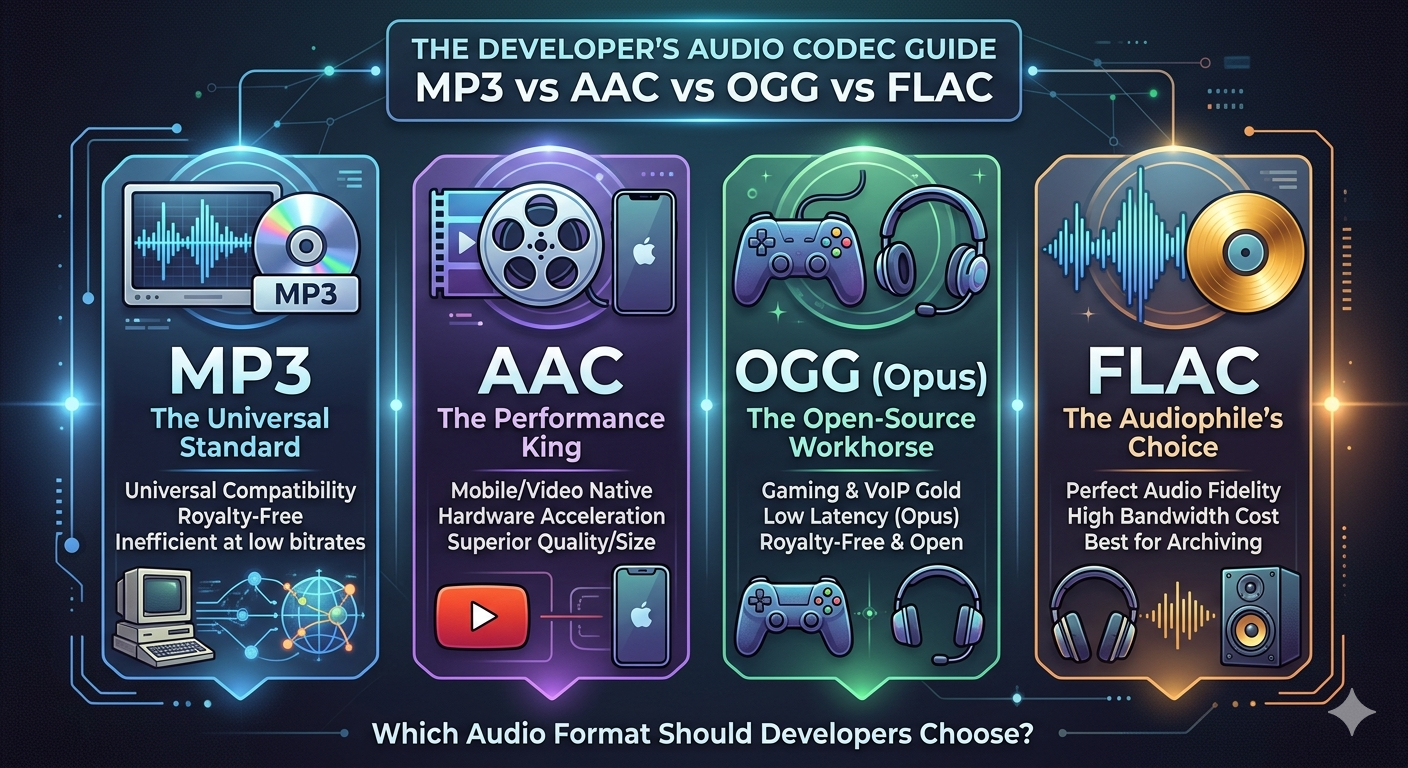
Selecting the right audio format is a high-stakes decision for developers. Whether you are building a mobile game, a streaming platform, or a web-based UI, the choice between MP3, AAC, OGG, and FLAC affects everything from server costs and bandwidth to battery life and user experience.
In 2026, the landscape has shifted. While MP3 is the “old reliable,” newer standards like Opus (often housed in Ogg containers) and AAC have become the professional go-tos. Here is your definitive guide to choosing the right audio format for your development project.
What Are Audio File Formats?
Audio file formats define how sound data is stored, compressed, and played. They affect:
- Audio quality
- File size
- Streaming performance
- Device compatibility
- Storage requirements
- Licensing and patent concerns
For developers, selecting the wrong format can increase bandwidth costs, reduce playback compatibility, or degrade user experience.
1. MP3 (MPEG Audio Layer III)
MP3 is the most widely recognized audio format in the world. Introduced in the 1990s, it became the standard for digital music because it dramatically reduced file sizes while maintaining acceptable sound quality.
Key Features of MP3
- Lossy compression
- Small file size
- Universal compatibility
- Fast streaming and downloading
Advantages
Excellent Compatibility
- MP3 works almost everywhere including browsers, smartphones, desktop software, car systems, smart TVs, and embedded devices.
Small File Size
- MP3 compresses audio efficiently, making it ideal for streaming and downloading.
Easy Integration
- Most programming languages, libraries, and frameworks support MP3 decoding and encoding.
Disadvantages
- Lower audio quality than newer formats
- Quality degrades at lower bitrates
- Not ideal for professional audio archiving
Best Use Cases
- Music players
- Podcasts
- Web audio playback
- Legacy systems
- Downloadable audio files
2. AAC (Advanced Audio Coding)
AAC was designed as the successor to MP3 and delivers better audio quality at similar or lower bitrates. It is widely used by major streaming platforms and mobile ecosystems.
Key Features of AAC
- Lossy compression
- Better efficiency than MP3
- Improved sound quality
- Strong mobile support
Advantages
Better Compression Efficiency
- AAC produces smaller files than MP3 while preserving higher quality.
Superior Streaming Performance
- Ideal for streaming apps where bandwidth matters.
Mobile Optimization
- AAC is deeply integrated into iOS, Android, and modern media players.
Disadvantages
- Less universally supported than MP3 on older systems
- Patent/licensing considerations in some contexts
Best Use Cases
- Music streaming apps
- Mobile applications
- Video platforms
- Podcasts with bandwidth optimization
3. OGG (Ogg Vorbis)
OGG usually refers to Ogg Vorbis, an open-source lossy audio format. It is popular among developers who want royalty-free alternatives.
Key Features of OGG
- Open-source format
- Lossy compression
- Good quality-to-size ratio
- No licensing fees
Advantages
Royalty-Free
- A major benefit for startups and open-source projects.
Good Audio Quality
- OGG often performs better than MP3 at similar bitrates.
Developer Friendly
- Ideal for Linux, gaming engines, and browser-based applications.
Disadvantages
- Lower compatibility in some legacy devices
- Less mainstream consumer recognition
Best Use Cases
- Open-source applications
- Browser games
- Linux software
- Indie game development
4. FLAC (Free Lossless Audio Codec)
FLAC is a lossless audio format, meaning it preserves original audio quality without sacrificing data. Unlike MP3, AAC, or OGG, FLAC does not discard sound information.
Key Features of FLAC
- Lossless compression
- High audio quality
- Larger file sizes
- Open-source
Advantages
Perfect Audio Preservation
- FLAC retains original sound data, making it excellent for professional workflows.
Better Than WAV for Storage
- FLAC reduces file size while keeping lossless quality.
Archival Friendly
- Perfect for long-term storage and editing.
Disadvantages
- Large files
- Higher bandwidth consumption
- Not ideal for casual streaming
Best Use Cases
- Audio archiving
- Music production
- Editing software
- High-end streaming services
Feature Comparison Table
| No. | Feature | MP3 | AAC | OGG | FLAC |
|---|---|---|---|---|---|
| 1 | Compression Type | Lossy | Lossy | Lossy | Lossless |
| 2 | File Size | Small | Smaller than MP3 | Small | Large |
| 3 | Audio Quality | Good | Better than MP3 | Very Good | Excellent |
| 4 | Compatibility | Excellent | Very Good | Good | Good |
| 5 | Open Source | No | No | Yes | Yes |
| 6 | Streaming Friendly | Yes | Excellent | Good | Limited |
| 7 | Archiving | No | No | No | Excellent |
Which Audio Format Should Developers Choose?
The answer depends entirely on project requirements.
Choose MP3 If:
- You need maximum compatibility
- Supporting older devices matters
- Building downloadable music or podcast systems
MP3 is the “works everywhere” format.
Choose AAC If:
- You are building streaming apps
- Mobile-first performance matters
- You want better compression efficiency
AAC is generally the best balance of quality and size.
Choose OGG If:
- You need royalty-free audio
- Building open-source software
- Developing browser games or Linux apps
OGG is the developer-friendly open alternative.
Choose FLAC If:
- Audio quality is critical
- You need editing or archival workflows
- Storage is less important than fidelity
FLAC is best for professional and premium audio systems.
Developer Recommendations by Project Type
Music Streaming Platform
Recommended: AAC
Reason: Better quality at smaller sizes improves streaming efficiency.
Podcast Hosting Platform
Recommended: MP3 or AAC
Reason: Broad compatibility plus manageable bandwidth.
Open Source Audio App
Recommended: OGG
Reason: Royalty-free and open ecosystem.
Audio Editing Software
Recommended: FLAC
Reason: Lossless quality preserves original data.
Web Game
Recommended: OGG
Reason: Smaller files plus licensing freedom.
Final Thoughts
There is no single “best” audio format for every project.
-	MP3 remains king for compatibility
-	AAC is ideal for streaming and mobile apps
-	OGG is best for open-source development
-	FLAC is perfect for professional audio quality
Developers should choose based on application goals, bandwidth limits, licensing requirements, and user expectations. The smartest decision is matching the format to your software architecture rather than blindly following popularity.
FAQ
Q1: Does AAC sound better than MP3?
A: Yes, AAC is more efficient and preserves more detail than MP3 at the same bitrate.
Q2: Is OGG Vorbis better than MP3 for games?
A: Yes, OGG supports seamless looping and gapless playback, which MP3 struggles with.
Q3: Is FLAC worth it for web apps?
A: Generally no, as the large file sizes lead to slow load times and high data costs for users.
Q4: Which format saves the most battery on mobile?
A: AAC usually wins here because most smartphones have dedicated hardware to decode it efficiently.
Q5: Can all browsers play OGG files?
A: Most modern browsers (Chrome, Firefox, Edge) support OGG, while Safari support varies by version and container.