Last Updated: 21 May, 2025
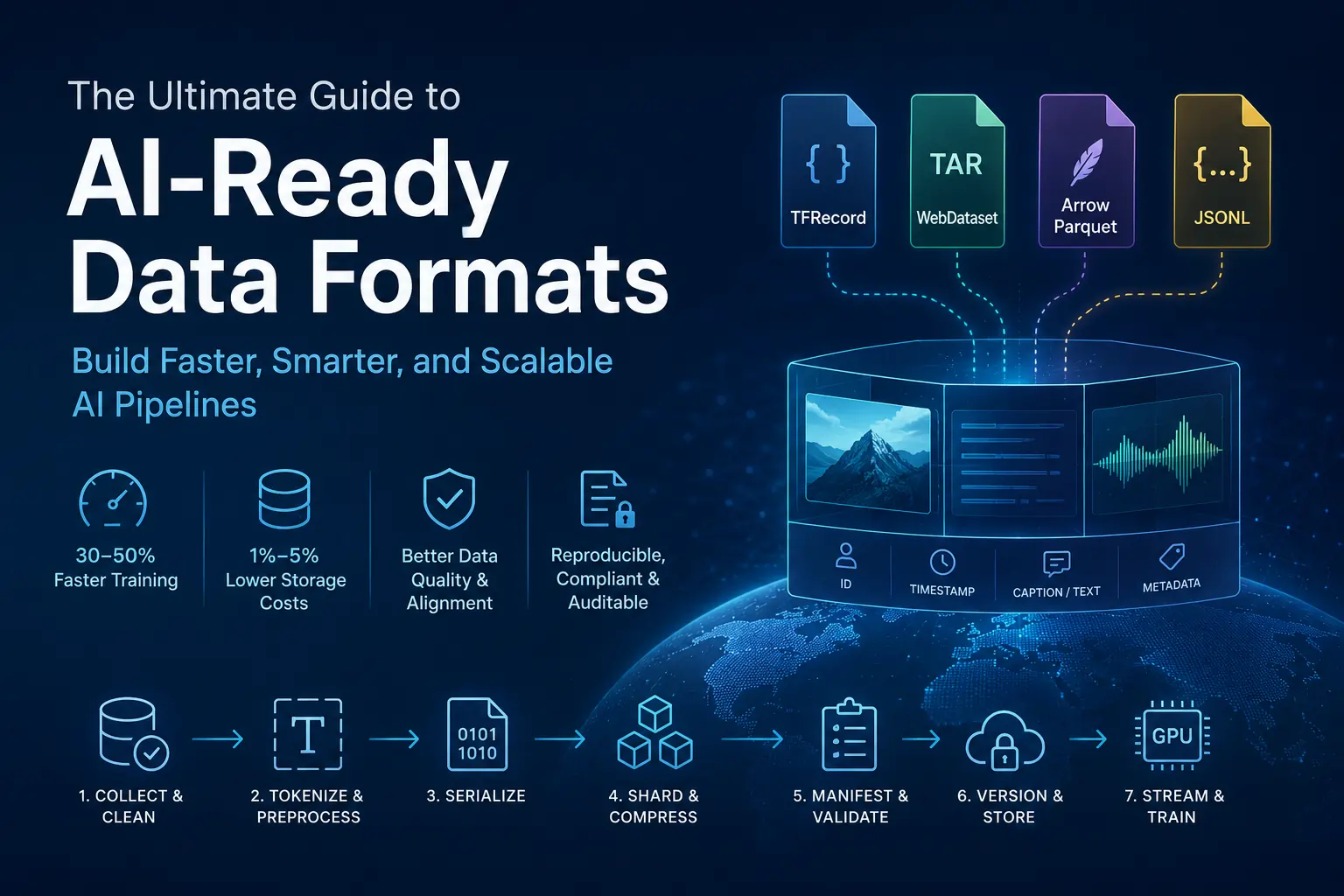
TL;DR – The file format you pick can shave 30‑50 % off training time, cut storage costs by 1 %–5 %, and keep your multi‑modal models from tripping over mis‑aligned data. The sweet spot is a streaming‑ready, column‑oriented binary container (TFRecord, WebDataset, Arrow/Parquet) that stores pre‑tokenized text and pre‑encoded media in a single, version‑controlled shard.
Why File‑Format Matters for AI Training
| Fact | What it means for you |
|---|---|
| Binary, column‑oriented formats are 30‑50 % faster than CSV or plain text | Pick a format that talks directly to your hardware (GPU/TPU) and pipeline (TensorFlow, PyTorch, Spark). |
| Inconsistent tokenization or image decoding hurts model quality | Freeze the preprocessing pipeline once, then store the already‑tokenized or pre‑encoded representation. |
| Petabyte‑scale LLMs save millions of dollars with a 1 % size reduction | Use compressed, sharded containers (ZSTD‑TFRecord, Arrow/Parquet with dictionary encoding). |
| Multi‑modal models need synchronized alignment metadata | Keep timestamps, bounding boxes, caption IDs inside the same record instead of in separate files. |
| Regulatory compliance now demands immutable, hash‑verified data | Emit a manifest (JSON/YAML) that records schema, checksum, provenance, and version. |
Bottom line: the format is the first line of defense against slow I/O, noisy data, and compliance headaches.
Core Concepts & Terminology (Quick Reference)
| Concept | One‑sentence definition | Typical use‑case |
|---|---|---|
| Sharding | Splitting a massive dataset into many small, independently readable files (e.g., 1 GB shards). | Parallel loading on a distributed training cluster. |
| Streaming‑Ready Format | Files that can be read sequentially without random seeks (TFRecord, WebDataset .tar). | Training directly from S3/GCS without a local copy. |
| Columnar Storage | Data stored by column rather than row (Parquet, Arrow). | Efficient filtering of a single modality (e.g., load only captions). |
| Self‑Describing Schema | The file embeds its own field names and types. | Guarantees compatibility across code versions. |
| Lazy Decoding / Pre‑Tokenization | Storing already‑tokenized text (int‑IDs) or pre‑computed embeddings. | Cuts preprocessing time 2‑5× during each epoch. |
| Multi‑Modal Record | One logical record that bundles image, text, audio, and metadata. | Enables synchronized sampling for vision‑language or audio‑text models. |
| Manifest / Index File | Small JSON/YAML that lists all shards, checksums, and per‑shard stats. | Fast validation, resumable training, audit trails. |
| Data‑Versioning | Treating data like code (DVC, LakeFS, Pachyderm). | Reproducible experiments and regulatory compliance. |
Choosing the Right Format
| Format | Modality support | Compression | Streaming | Schema | Ecosystem |
|---|---|---|---|---|---|
| TFRecord | Any binary blob → text, image, audio | Built‑in GZIP/ZSTD | ✅ | Implicit (via tf.io.parse_example) | TensorFlow, PyTorch (torchdata), HuggingFace datasets |
WebDataset (.tar, .tar.gz) | Multi‑modal (image + text + audio) | External (gzip, zstd) | ✅ | Implicit key‑value | PyTorch DataLoader, webdataset lib |
| Apache Arrow / Parquet | Columnar, nested structs, binary blobs | Snappy/ZSTD/LZ4 | ✅ (Arrow Flight) | ✅ (self‑describing) | Spark, Pandas, PyArrow, HuggingFace datasets |
| JSONL / NDJSON | Human‑readable, flexible | None (or gzip) | ❌ | Implicit | Quick prototyping, small datasets |
| LMDB | Fast random reads (key‑value) | None (store compressed blobs) | ❌ | Implicit | Retrieval‑augmented generation |
| HDF5 | Hierarchical groups, large arrays | Built‑in gzip/lzf | ❌ (needs chunking) | Implicit | Scientific data, audio spectrograms |
Rule of thumb:
- Training at scale → TFRecord, WebDataset, or Arrow/Parquet (they stream, compress, and support sharding).
- Exploratory work → JSONL (human‑readable, easy to edit).
- Heavy random access (e.g., retrieval‑augmented generation) → LMDB.
Step‑by‑Step Blueprint (From Raw Files to Production‑Ready Shards)
Define a single source‑of‑truth schema
message MultiModalExample {
  bytes image = 1;                // JPEG‑XL or AVIF
  repeated int32 caption = 2;    // token IDs
  bytes audio = 3;                // Opus or FLAC
  map<string, string> meta = 4;  // source_id, timestamp, etc.
}
Store this
.proto(or Arrow schema) alongside the dataset.Collect & clean raw assets
- Text: Unicode‑NFKC, strip control chars, deduplicate.
- Images: Convert to lossless PNG first, then optionally lossy JPEG‑XL (quality 85‑90 %).
- Audio: Resample to 16 kHz, 16‑bit PCM; encode with Opus (lossy) or FLAC (lossless).
Pre‑process / Tokenize
Use the exact tokenizer you’ll feed the model (e.g.,tiktokenfor GPT‑NeoX). Store the resultingint32[]token IDs directly in the record.Serialize each record
Pick a fast binary serializer: Protocol Buffers, FlatBuffers, or Arrow IPC. The goal is a single byte string per example that can be written to a TFRecord or a tarball.Shard & compress
- Target shard size: 256 MiB – 1 GiB (optimal for S3 GET range requests).
- Compress with Zstandard (level 3‑5) – fast decompression, good ratio.
- Naming convention:
train-00000-of-01000.tfrecord.zst.
Generate a manifest
[
  {
    "shard": "train-00000-of-01000.tfrecord.zst",
    "checksum": "sha256:ab12…",
    "num_examples": 12456,
    "avg_seq_len": 256,
    "git_hash": "d3f9c1e"
  },
  …
]
The manifest is the single source of truth for validation, resumable training, and audit.
Validate
Randomly sample 0.1 % of records, decode each field, and run sanity checks (image decode, token length, audio duration). Compute global stats (vocab coverage, resolution distribution) and store them in the manifest.Version & store immutably
Push shards + manifest to an immutable bucket (gs://my‑project/datasets/v1/). Tag with a semantic version (v1.0.0) and register the snapshot in a data‑versioning system (DVC, LakeFS).Load in your training loop
# PyTorch + WebDataset example
import webdataset as wds, torch, torchvision, torchaudio

def decode(sample):
    img = torchvision.io.decode_image(sample["jpg"], mode=torchvision.io.ImageReadMode.RGB)
    txt = torch.tensor([int(t) for t in sample["txt"].decode().split()], dtype=torch.long)
    wav, _ = torchaudio.load(io.BytesIO(sample["wav"]))
    return {"image": img, "caption": txt, "audio": wav}

ds = (wds.WebDataset("s3://my-bucket/train-{00000..00999}.tar.zst")
      .decode("torchrgb")
      .map(decode)
      .batched(64)
      .prefetch(2))

loader = torch.utils.data.DataLoader(ds, num_workers=8)
for batch in loader:
    # feed to model …
    pass
Emerging Trends & Future‑Proofing
| Trend | Why it matters now | Quick action |
|---|---|---|
| Unified multi‑modal containers (Meta’s MDS, DeepLake) | One file type for text, image, video, audio, and embeddings, with built‑in versioning. | Try a pilot with DeepLake; it integrates with LangChain and LlamaIndex. |
| Zero‑copy GPU‑direct storage | NVMe‑over‑Fabric + GPUDirect lets you stream compressed shards straight into GPU memory. | When you have an NVMe‑SSD pool, enable torch.utils.data.DataLoader(persistent_workers=True). |
| Schema‑evolution friendly formats | Arrow 13+ lets you add/remove fields without rewriting the whole dataset. | Prefer Arrow/Parquet for any pipeline that may later ingest depth maps, video, or extra metadata. |
| Self‑supervised pre‑encoding | Storing CLIP image embeddings or wav2vec audio embeddings cuts compute by 2‑3× for fine‑tuning. | Add an extra column image_emb (float16) to your Arrow table; keep the raw image for future experiments. |
| Privacy‑preserving storage | Encrypted TFRecord + secure enclaves are emerging for GDPR‑heavy domains. | Evaluate tf.io.TFRecordWriter with a custom encryption wrapper if you handle PII. |
| Data‑centric AI metrics | Data quality scores (OCR confidence, blur metric, SNR) are now first‑class hyper‑parameters. | Store per‑shard quality scores in the manifest and filter low‑quality shards during training. |
Production‑Ready Checklist
- Schema file (
.protoor Arrow schema) stored next to the data. - All shards compressed with a fast codec (ZSTD‑L3 recommended).
- Shard size between 256 MiB and 1 GiB.
- Manifest includes checksum, record count, per‑shard stats, and git hash of preprocessing code.
- Immutable version control (DVC, LakeFS, or similar).
- Data quality metrics logged per shard.
- Privacy audit completed (PII redaction, optional encryption).
- End‑to‑end test loader that can read a random shard without errors.
- README that explains schema, preprocessing steps, and how to regenerate shards.
Following this blueprint will keep your training pipelines fast, cheap, and reproducible—the three pillars every modern LLM team needs.
Tags: data‑engineering multi‑modal‑llm training‑pipelines
Slug: how-to-prepare-data-file-formats-for-ai-training