Terakhir Diperbarui: 25 May, 2026
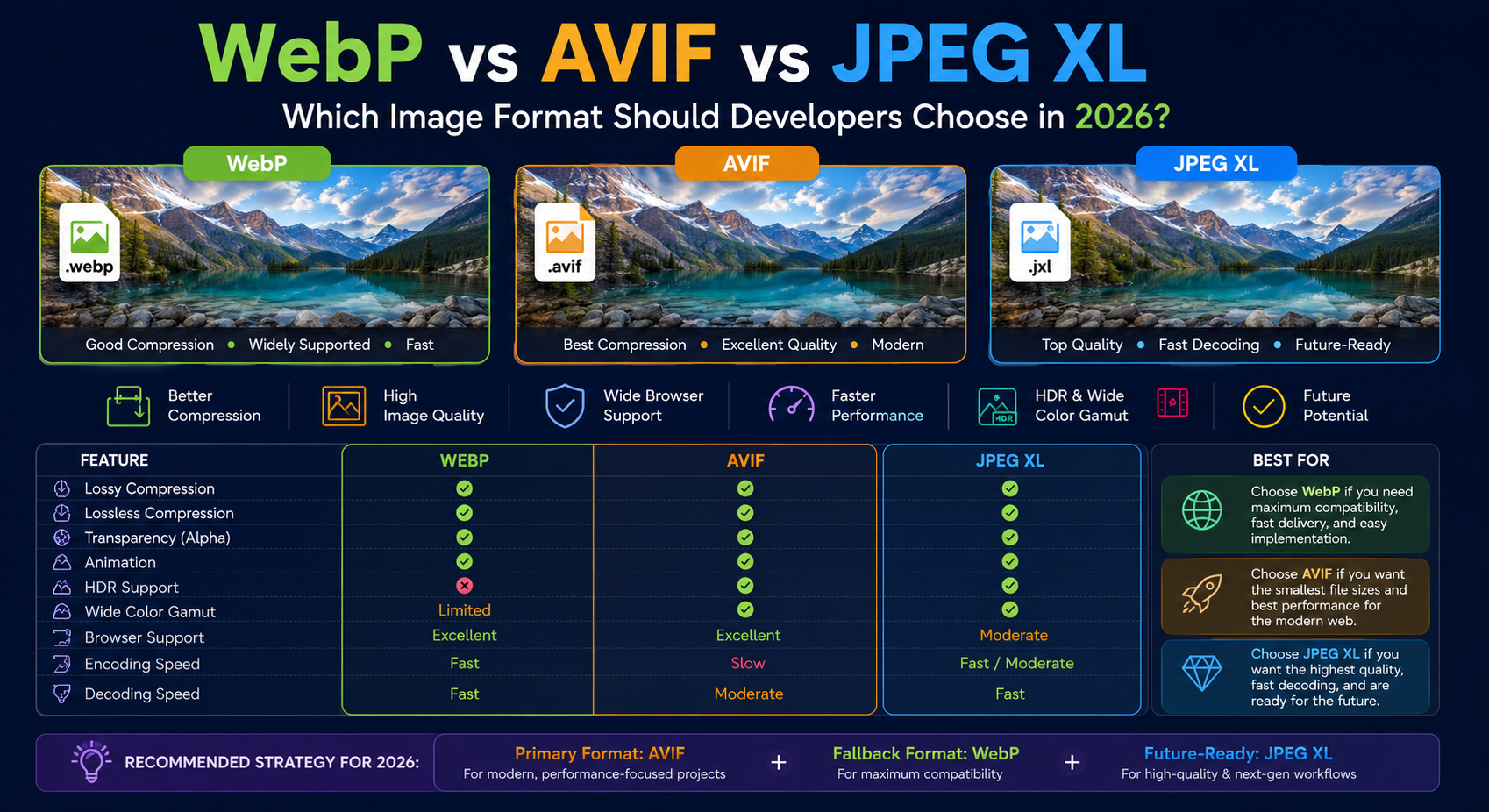
Images are no longer just design assets—they directly impact website speed, SEO rankings, user experience, bandwidth costs, and even conversion rates. In 2026, developers have more choices than ever when optimizing images for the web and applications.
Traditional formats like JPEG and PNG still exist, but modern alternatives such as WebP, AVIF, and JPEG XL are redefining image delivery standards. Each format promises better compression, improved quality, and smaller file sizes, but choosing the right one is not always straightforward.
Should developers continue relying on WebP? Is AVIF finally mature enough for production? And does JPEG XL deserve a second chance despite its complicated browser journey? This guide compares WebP, AVIF, and JPEG XL across performance, compatibility, image quality, encoding speed, and practical developer use cases to help you decide which image format to use in 2026.
Apa Itu WebP?
WebP is an image format developed by Google to replace older formats like JPEG, PNG, and GIF.
Mendukung:
- Lossy compression
- Lossless compression
- Transparency (alpha channel)
- Animation
WebP became widely adopted because it offers significantly smaller file sizes than JPEG and PNG while maintaining acceptable visual quality.
Manfaat Utama WebP
- Excellent browser compatibility
- Smaller file sizes than JPEG
- Supports transparency like PNG
- Supports animated images like GIF
Keterbatasan WebP
- Compression efficiency is now outperformed by AVIF and JPEG XL
- Quality can degrade at aggressive compression levels
- Limited HDR and advanced color features
Apa Itu AVIF?
AVIF stands for AV1 Image File Format and is based on the AV1 video codec. It is designed for next-generation image compression and offers outstanding compression efficiency.
Mendukung AVIF:
- Lossy compression
- Lossless compression
- HDR
- Wide color gamut
- Transparency
- Animation
AVIF is often considered the most space-efficient image format currently available for web delivery.
Manfaat Utama AVIF
- Superior compression compared to WebP
- Excellent image quality at lower bitrates
- HDR and 10-bit color support
- Great for responsive web images
Keterbatasan AVIF
- Slower encoding times
- More CPU-intensive decoding
- Complex implementation pipelines
Apa Itu JPEG XL?
JPEG XL is a next-generation image format created by the Joint Photographic Experts Group (JPEG) committee. It was designed as a universal successor to JPEG with better compression, higher quality, and backward-friendly migration.
Mendukung JPEG XL:
- Lossy compression
- Lossless compression
- Progressive decoding
- Animation
- HDR
- Wide gamut
- Alpha transparency
Unlike AVIF, JPEG XL prioritizes both compression and developer usability.
Manfaat Utama JPEG XL
- Excellent compression ratios
- Very fast decoding
- Better progressive rendering
- High-fidelity image preservation
- JPEG recompression without quality loss
Keterbatasan JPEG XL
- Browser adoption remains inconsistent
- Ecosystem tooling still growing
Perbandingan WebP vs AVIF vs JPEG XL
1. Efisiensi Kompresi
Compression matters because smaller images improve:
- Page speed
- CDN costs
- Mobile performance
- Core Web Vitals
WebP
WebP generally reduces JPEG sizes by 25–35%.
Terbaik untuk: General-purpose web optimization.
AVIF
AVIF often delivers 40–60% smaller files than JPEG while preserving impressive detail.
Terbaik untuk: Kompresi maksimum.
JPEG XL
JPEG XL usually competes closely with AVIF and sometimes beats it depending on image content.
Terbaik untuk: Kompresi seimbang dan kecepatan.
Pemenang: AVIF
AVIF usually provides the smallest file sizes.
2. Kualitas Gambar
Compression is useless if quality suffers.
WebP
WebP performs well, but artifacts become noticeable at aggressive compression.
Penilaian Kualitas: Baik
AVIF
AVIF preserves detail extremely well, especially for:
- Gradients
- Photography
- HDR assets
Penilaian Kualitas: Luar Biasa
JPEG XL
JPEG XL often produces more visually pleasing results than AVIF, especially for:
- Fine textures
- Text
- Illustrations
Penilaian Kualitas: Luar Biasa+
Pemenang: JPEG XL
JPEG XL often offers the best visual fidelity.
3. Dukungan Peramban pada 2026
Adoption is critical for production deployment.
Dukungan WebP
Supported by:
- Chrome
- Firefox
- Safari
- Edge
- Opera
Cakupan: Hampir universal
Dukungan AVIF
Supported by:
- Chrome
- Firefox
- Safari
- Edge
AVIF is now widely supported across major browsers.
Cakupan: Sangat baik
Dukungan JPEG XL
JPEG XL support remains mixed in 2026. Some browsers and ecosystems support it, while others still lag.
Cakupan: Terbatas hingga sedang
Pemenang: WebP
WebP remains the safest compatibility choice.
4. Kecepatan Pengkodean
Encoding speed matters for:
- Build pipelines
- CMS uploads
- Dynamic image processing
WebP
Fast encoding and broad tooling.
Kinerja: Cepat
AVIF
Encoding can be slow, especially at higher quality levels.
Kinerja: Lambat
JPEG XL
Much faster than AVIF while maintaining strong compression.
Kinerja: Cepat hingga sedang
Pemenang: WebP / JPEG XL
Tie depending on workflow.
5. Kecepatan Dekode
Decoding affects:
- Mobile devices
- CPU usage
- Rendering speed
WebP
Fast decoding.
AVIF
Can be CPU-heavy.
JPEG XL
Very fast decoding.
Pemenang: JPEG XL
Best runtime efficiency.
6. Dukungan Animasi
WebP
Excellent animation replacement for GIF.
AVIF
Supports animation but tooling is less mature.
JPEG XL
Supports animation with better compression.
Pemenang: JPEG XL
Most advanced animation capabilities.
Tabel Perbandingan Fitur
| No. | Fitur | WebP | AVIF | JPEG XL |
|---|---|---|---|---|
| 1 | Kompresi Lossy | Ya | Ya | Ya |
| 2 | Kompresi Lossless | Ya | Ya | Ya |
| 3 | Transparansi | Ya | Ya | Ya |
| 4 | Animasi | Ya | Ya | Ya |
| 5 | Dukungan HDR | Tidak | Ya | Ya |
| 6 | Gamut Warna Luas | Terbatas | Ya | Ya |
| 7 | Dukungan Peramban | Sangat baik | Sangat baik | Sedang |
| 8 | Kecepatan Pengkodean | Cepat | Lambat | Cepat |
| 9 | Kecepatan Dekode | Cepat | Sedang | Cepat |
| 10 | Rasio Kompresi | Baik | Luar Biasa | Luar Biasa |
Format Apa yang Harus Dipilih Pengembang pada 2026?
The answer depends on priorities.
Gunakan WebP jika:
You want the safest and easiest production choice.
Gunakan AVIF jika:
You prioritize compression and modern performance.
Gunakan JPEG XL jika:
You want the highest quality and are comfortable with evolving browser support.
Strategi yang Direkomendasikan untuk 2026
For most developers, the best practical strategy is:
Format Utama: AVIF
Use AVIF for:
- Hero images
- Product photos
- Responsive assets
Format Cadangan: WebP
Use WebP where compatibility matters.
Format Eksperimental/Tingkat Tinggi: JPEG XL
Use JPEG XL for:
- Professional imaging
- Internal systems
- Future-ready asset pipelines
This hybrid approach gives developers the best balance of:
- Compatibility
- Speed
- Quality
- Future readiness
Kesimpulan Akhir
In 2026:
- WebP = safest universal format
- AVIF = best compression winner
- JPEG XL = best quality and future potential
There is no single winner for every project. Instead of choosing one format blindly, developers should align image format strategy with:
- Performance goals
- Browser audience
- Workflow constraints
- Content type
The future of web imaging is multi-format, and smart developers will use each format where it performs best.
FAQ
Q1: Apakah AVIF lebih baik daripada WebP pada 2026?
A: Yes, AVIF usually offers better compression and quality, but WebP is easier to deploy.
Q2: Apakah JPEG XL sudah mati?
A: No, JPEG XL is still relevant and technically impressive despite browser adoption challenges.
Q3: Haruskah saya mengganti semua gambar WebP dengan AVIF?
A: Not necessarily. A hybrid AVIF + WebP fallback strategy is often best.
Q4: Format mana yang terbaik untuk SEO?
A: AVIF generally offers the best SEO advantage due to smaller file sizes.
Q5: Format mana yang memiliki kualitas gambar terbaik?
A: JPEG XL often delivers the best visual fidelity.