Last Updated: 08 Jun, 2026
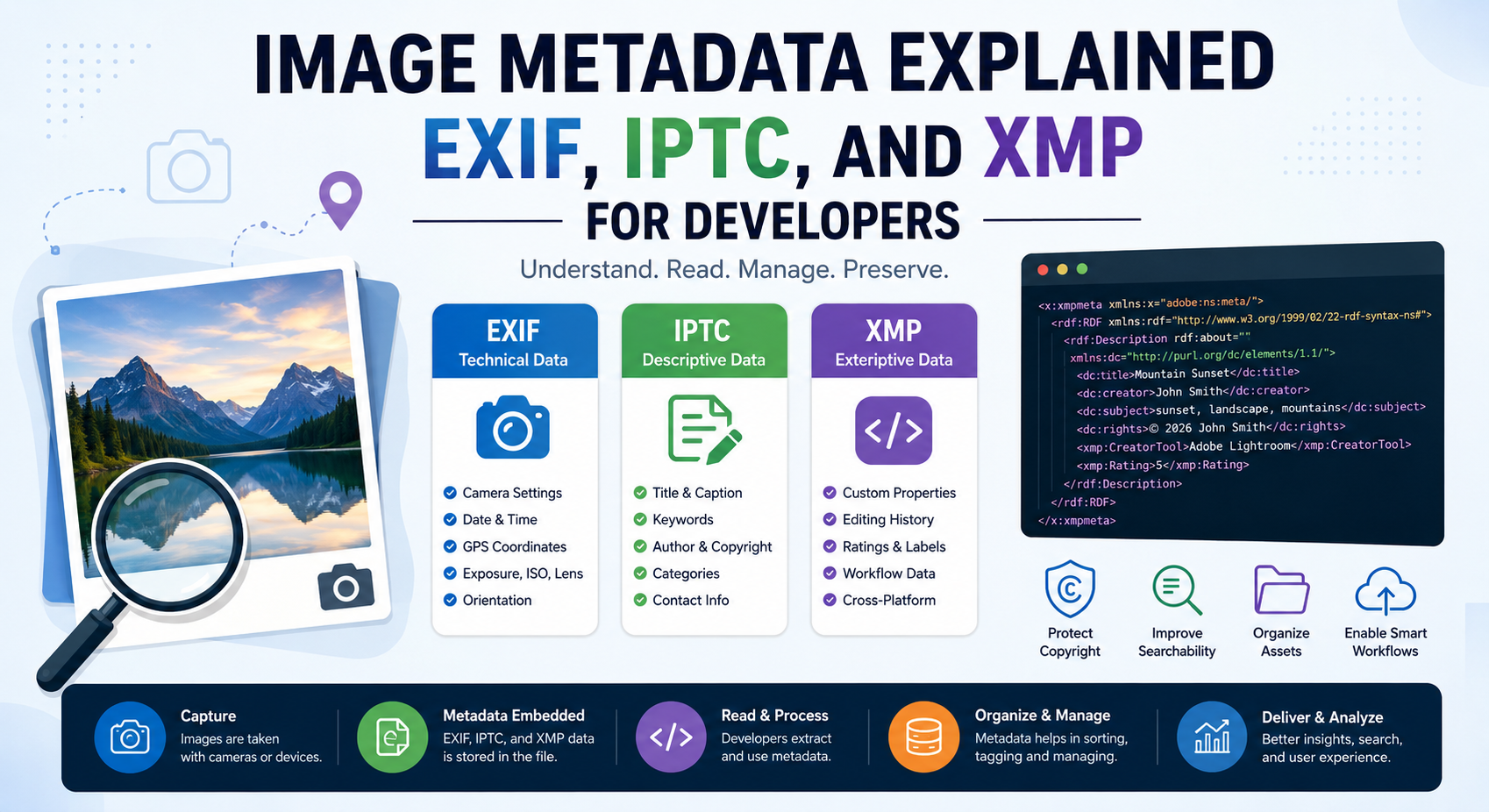
Images contain far more information than what appears visually on the screen. Hidden behind every digital image lies metadata, which stores valuable information such as camera settings, GPS coordinates, copyrights, keywords, editing history, and much more.
Whether you’re building an image gallery, digital asset management system, AI-powered application, or a content management platform, understanding image metadata standards is essential. The three most common metadata standards are EXIF, IPTC, and XMP.
In this article, we’ll explain how these metadata standards work, compare their capabilities, and explore how developers can leverage them in modern applications.
📌 Why Is Image Metadata Important?
Image metadata plays a critical role in organizing and managing image collections.
Key Benefits
- Improves image search and indexing.
- Enables copyright protection.
- Provides technical camera information.
- Simplifies image categorization.
- Supports Digital Asset Management (DAM) systems.
- Preserves editing and workflow history.
- Supplies additional context for AI and machine learning applications.
🔹 What Is EXIF Metadata?
Understanding EXIF
EXIF (Exchangeable Image File Format) is the most widely used metadata standard. Nearly every smartphone and digital camera automatically embeds EXIF information into photographs.
Typical EXIF Fields
| Information | Example |
|---|---|
| Camera Manufacturer | Canon |
| Camera Model | EOS R6 |
| Lens | RF 24-70mm |
| ISO | 400 |
| Aperture | f/2.8 |
| Shutter Speed | 1/500 |
| Focal Length | 70mm |
| Date and Time | 2026-06-08 |
| GPS Coordinates | Latitude & Longitude |
| Orientation | Landscape |
Advantages of EXIF
✔ Automatically generated.
✔ Supported by almost every device.
✔ Useful for sorting photos by date and location.
✔ Valuable for photography applications.
Limitations
❌ Limited support for keywords.
❌ Cannot store complex workflow information.
❌ Some image optimization tools strip EXIF metadata.
🔹 What Is IPTC Metadata?
Understanding IPTC
IPTC (International Press Telecommunications Council) metadata was originally developed for newspapers and publishing organizations. It focuses on descriptive information instead of technical camera settings.
Common IPTC Fields
- Title.
- Description.
- Caption.
- Keywords.
- Author name.
- Copyright information.
- Contact information.
- Categories.
- Geographic location.
Advantages of IPTC
✔ Excellent for image catalogs.
✔ Supports copyright protection.
✔ Makes searching easier.
✔ Widely used by news agencies and photographers.
Limitations
❌ Less flexible than XMP.
❌ Older architecture.
❌ Limited extensibility.
🔹 What Is XMP Metadata?
Understanding XMP
XMP (Extensible Metadata Platform) was introduced by Adobe and has become the modern standard for metadata management.
Unlike EXIF and IPTC, XMP uses XML structures that support custom properties and rich workflows.
Typical XMP Fields
- Author information.
- Copyright.
- Ratings.
- Keywords.
- Captions.
- Editing history.
- Camera settings.
- Workflow data.
- User-defined custom fields.
Why Developers Prefer XMP
✔ XML-based.
✔ Highly extensible.
✔ Easy to parse.
✔ Supported by Photoshop and Lightroom.
✔ Perfect for Digital Asset Management systems.
🧠 EXIF vs IPTC vs XMP
| Feature | EXIF | IPTC | XMP |
|---|---|---|---|
| Camera Settings | ✔ | ✖ | ✔ |
| Keywords | Limited | ✔ | ✔ |
| Copyright Information | Limited | ✔ | ✔ |
| Editing History | ✖ | ✖ | ✔ |
| Custom Fields | ✖ | ✖ | ✔ |
| XML Structure | ✖ | ✖ | ✔ |
| Extensibility | Low | Medium | Excellent |
| DAM Support | Good | Good | Excellent |
🚀 Metadata in Popular Image Formats
| Image Format | EXIF | IPTC | XMP |
|---|---|---|---|
| JPEG | ✔ | ✔ | ✔ |
| TIFF | ✔ | ✔ | ✔ |
| PNG | Limited | Limited | ✔ |
| WebP | ✔ | ✔ | ✔ |
| HEIC | ✔ | ✔ | ✔ |
| AVIF | ✔ | ✔ | ✔ |
🔧 Reading Metadata Programmatically
Python Example
Pillow
from PIL import Image

img = Image.open("photo.jpg")
exif_data = img.getexif()

for tag, value in exif_data.items():
    print(tag, value)
Best for: Automation and image-processing pipelines.
JavaScript
exifr
import exifr from "exifr";

const metadata = await exifr.parse("photo.jpg");

console.log(metadata);
Best for: Node.js and browser applications.
Java Example:
metadata-extractor
Metadata metadata =
    ImageMetadataReader.readMetadata(new File("photo.jpg"));

for (Directory directory : metadata.getDirectories()) {
    for (Tag tag : directory.getTags()) {
        System.out.println(tag);
    }
}
Best for: Enterprise Java applications.
.NET Example
MetadataExtractor
var directories =
    ImageMetadataReader.ReadMetadata("photo.jpg");

foreach (var directory in directories)
{
    foreach (var tag in directory.Tags)
    {
        Console.WriteLine(tag);
    }
}
Best for: ASP.NET Core and desktop applications.
📈 Future of Image Metadata
Modern image management systems increasingly rely on:
- AI-generated keywords.
- Semantic image search.
- Rights management.
- Cloud-based DAM systems.
- Intelligent indexing.
Because of its flexibility and XML-based architecture, XMP is expected to remain the dominant metadata framework.
🏁 Conclusion
Image metadata goes far beyond pixels. Understanding EXIF, IPTC, and XMP enables developers to build smarter image-processing applications and digital asset management systems.
- EXIF excels at camera information.
- IPTC focuses on descriptions and copyrights.
- XMP provides the flexibility required for modern workflows.
Together, these standards make images easier to organize, search, and protect.
Q1: What is image metadata?
A: Image metadata contains hidden information about an image, including camera settings, keywords, copyrights, and editing history.
Q2: What is EXIF metadata used for?
A: EXIF stores technical information such as ISO, aperture, date, time, and GPS coordinates.
Q3: Why is XMP considered the most flexible metadata format?
A: XMP is XML-based and supports custom properties and workflow information.
Q4: Can metadata be removed from images?
A: Yes. Compression tools and image editors can remove metadata intentionally or accidentally.
Q5: Which image formats support metadata?
A: JPEG, TIFF, WebP, HEIC, AVIF, and several other formats support EXIF, IPTC, and XMP metadata.