Ultimo aggiornamento: 30 giu, 2026
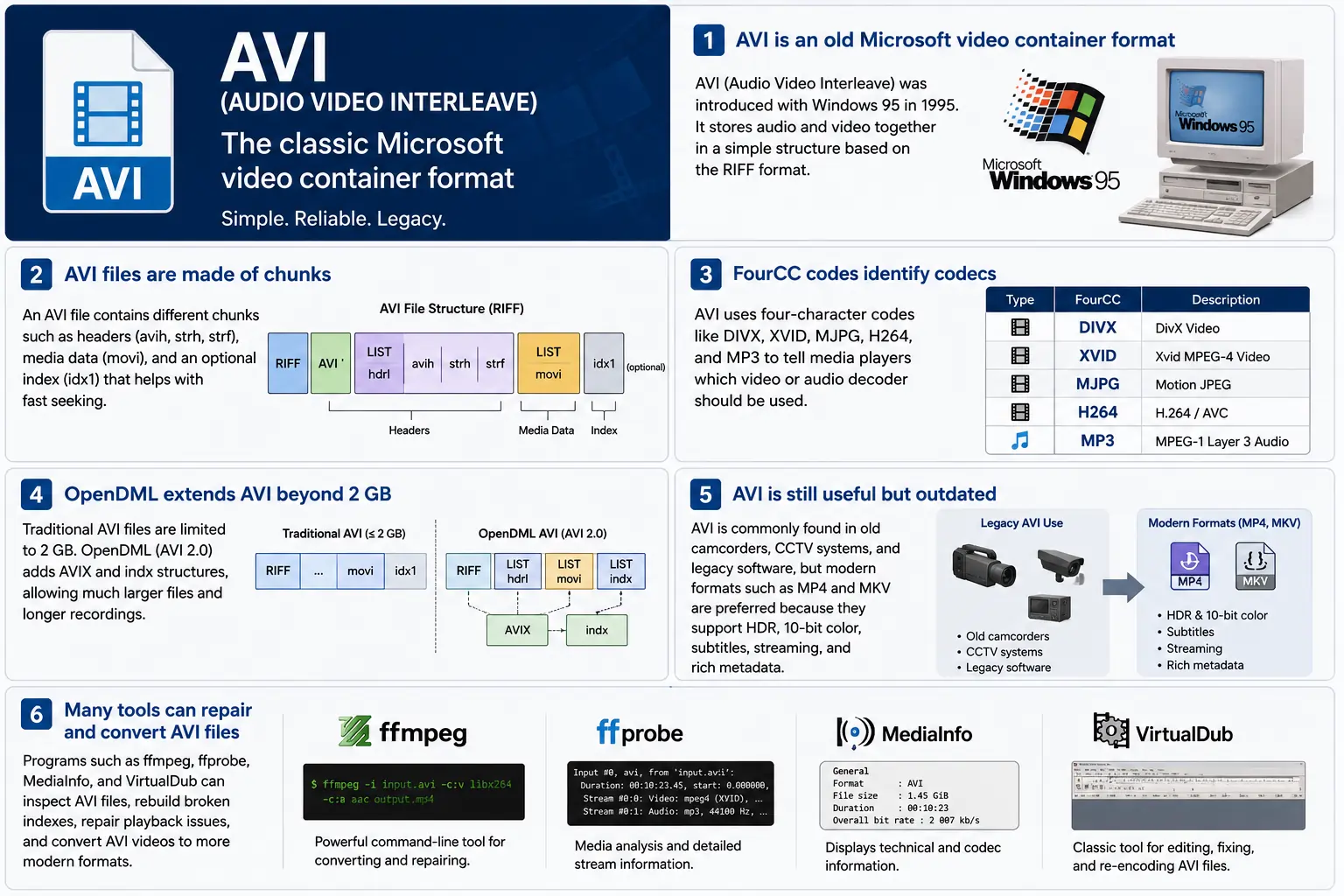
TL;DR – AVI (Audio Video Interleave) è il primo contenitore “video digitale” di Microsoft, nato con Windows 95. È un file semplice basato su RIFF che interseca blocchi compressi di video e audio in modo che un lettore possa leggerli in sincronia. Il formato è ancora supportato da Windows Media Player e da una serie di strumenti open‑source, ma manca di funzionalità moderne come HDR, colore a 10 bit e metadati di streaming robusti. Se devi mai approfondire filmati legacy, comprendere la disposizione dei chunk, i codici FourCC e le estensioni OpenDML che sollevano il limite di 2 GB – è questo il nocciolo di AVI.
1. Che cos’è esattamente un file AVI?
- Nome completo: Audio Video Interleave
- Prima apparizione: Windows 95 (1995) – la risposta di Microsoft al “video digitale” sui PC consumer.
- Specifiche: Basato sullo standard RIFF (Resource Interchange File Format) del 1991. RIFF è un contenitore generico “basato su chunk”; AVI definisce semplicemente un insieme di chunk che contengono audio, video e dati di indicizzazione.
- Estensione file / MIME:
.avi–video/x-msvideo. - Obiettivo principale: Mantenere i flussi audio e video strettamente intercalati sul disco in modo che un ciclo di riproduzione ingenuo possa leggere un fotogramma video, poi il campione audio corrispondente, senza costosi seek.
- Stato legacy: Ancora riproducibile in Windows Media Player, DirectShow, VLC e innumerevoli altri lettori, ma non è un contenitore “moderno”. Nessun supporto nativo HDR, a 10 bit, bitrate variabile o metadati ricchi.
2. All’interno della scatola – Come funziona AVI
Lo scheletro del chunk RIFF
Un file AVI è semplicemente una serie di chunk:
RIFF <size> "AVI "          ; file header
  LIST "hdrl"               ; header list
    avih ...                ; main AVI header (global info)
    LIST "strl"             ; stream list (one per stream)
      strh ...              ; stream header (type, codec, timing)
      strf ...              ; stream format (codec‑specific data)
  LIST "movi"               ; interleaved media data
    00dc <size> <video frame>
    01wb <size> <audio block>
    …
  idx1 ...                  ; optional index for fast seeking
- ID chunk (4 byte) – ad es.,
avih,strh,movi. - Dimensione chunk (4 byte) – lunghezza dei dati che seguono (esclusi i campi ID e dimensione).
- Dati – il payload effettivo (intestazioni, frame grezzi, ecc.).
Poiché RIFF è estensibile, è possibile aggiungere nuovi tipi di chunk senza rompere i parser più vecchi – un design che ha mantenuto vivo AVI per decenni.
FourCC – Il Sussurratore di Codec
I codici a quattro caratteri (FourCC) sono il collante che indica a un lettore quale decoder caricare. Alcuni comuni che vedrai nei file AVI:
| FourCC | Codec (ffmpeg) | Uso tipico |
|---|---|---|
DIVX | mpeg4 (DivX) | MPEG‑4 Part 2 iniziale |
XVID | mpeg4 (Xvid) | MPEG‑4 open source |
MJPG | mjpeg | Motion‑JPEG (camcorder digitali) |
H264 | h264 | H.264/AVC (raro ma possibile) |
MP3 | mp3 | Flusso audio MP3 |
PCM | pcm_s16le | Audio PCM non compresso |
Il FourCC si trova nel chunk strh (identificatore del codec) e talvolta nel blocco strf (formato pixel, formato campione audio).
Temporizzazione e Sincronizzazione
AVI utilizza un semplice sistema time‑base:
- Intestazione globale (
avih):dwRate/dwScale→ fotogrammi al secondo. - Intestazione per flusso (
strh): il propriodwRate/dwScaleper audio o flussi video secondari.
Il lettore moltiplica il numero del fotogramma per scale/rate per calcolare un timestamp di presentazione (PTS). Se le scale non coincidono, vedrai il classico bug “l’audio si desincronizza” che perseguita gli strumenti legacy.
Il Chunk movi – Dove Vive il Media
Tutti i fotogrammi compressi si trovano nella LIST movi. Ogni fotogramma è preceduto da un chunk ID che indica se è video (00dc) o audio (01wb). L’ID codifica anche il numero del flusso, quindi un file con due tracce audio avrebbe 01wb e 02wb.
Poiché i dati sono già intercalati, un lettore può leggere un fotogramma video, poi il blocco audio successivo, e presentarli insieme senza dover cercare molto avanti. Quel modello di scrittura deterministico ha reso AVI popolare per i primi dispositivi di acquisizione che richiedevano scritture su disco a bassa latenza.
Indicizzazione (idx1) – Avanti Veloce, Riavvolgimento Veloce
Il chunk opzionale idx1 è una tabella di offset e dimensioni per ogni fotogramma in movi. Quando è presente, la ricerca è una semplice ricerca nella tabella. Se manca, i lettori devono scansionare il file al volo – il che può causare una pausa di “buffering” evidente su file di grandi dimensioni.
OpenDML (AVI 2.0) – Superare la Soglia dei 2 GB
La specifica originale RIFF limita il campo di dimensione di un chunk a un intero senza segno a 32‑bit → 2 GB dimensione massima del file. OpenDML (a volte chiamato AVI 2.0) ha introdotto:
AVIXLISTs – sezioni RIFF “estese” aggiuntive che possono seguire i primi 2 GB.indxchunk – un indice a 64‑bit.- Campi header extra per durate più lunghe.
La maggior parte degli strumenti moderni (ffmpeg, VLC) passa automaticamente a OpenDML quando l’output supera i 2 GB, ma molti lettori più vecchi si bloccano ancora sui chunk AVIX, quindi a volte si vedono soluzioni di compatibilità che dividono una lunga registrazione in diversi file AVI da 2 GB.
3. Dove Vive AVI nel 2024?
| Tendenza | Cosa Significa per AVI |
|---|---|
| Passaggio a MP4/MKV/ProRes | Le nuove produzioni preferiscono contenitori che supportano nativamente HDR, 10‑bit, VBR e ricchi metadati. AVI è raramente scelto per contenuti nuovi. |
| Hardware legacy | Vecchie telecamere CCTV, videocamere dei primi anni 2000 e alcuni motori di gioco emettono ancora AVI. Dovrai comunque importare quei file in un flusso di lavoro moderno. |
| Supporto open‑source | ffmpeg, libav, VLC, HandBrake e GStreamer mantengono vivi i parser AVI, ma spesso ri‑codificano in MP4/MKV per la distribuzione. |
| Rinascita di OpenDML | Le registrazioni di sorveglianza 4K che durano giorni superano rapidamente i 2 GB. OpenDML (AVIX) è ancora la soluzione preferita, anche se molti strumenti lo gestiscono in modo errato. |
| Rinforzo della sicurezza | I parser AVI storici accettavano dimensioni di chunk malformate, portando a CVE (ad es., CVE‑2020‑13144). Windows ora preferisce Media Foundation, che rifiuta molte stranezze legacy, spingendo gli sviluppatori verso pipeline più sicure. |
| Pipeline indipendenti dal contenitore | I moderni framework multimediali trattano AVI come un semplice elemento sorgente. Una volta che i dati sono demultiplexati in buffer grezzi, il contenitore diventa irrilevante per l’elaborazione a valle. |
In breve, AVI è vivo ma invecchiato – sopravvive dove è necessario hardware vecchio o una semplice memorizzazione interlacciata, ma non è la prima scelta per nuovi progetti.
4. Pratica: Lavorare con AVI Oggi
A. Uno sguardo a un’intestazione minima (hex)
52 49 46 46  00 00 00 00  41 56 49 20   ; "RIFF" + size + "AVI "
4C 49 53 54  20 00 00 00  68 64 72 6C   ; LIST "hdrl"
...
Il magic RIFF (52 49 46 46) indica a qualsiasi parser “questo è un file RIFF”. I successivi quattro byte rappresentano la dimensione totale del file (meno 8). L’identificatore "AVI " fissa il file nella famiglia AVI.
B. Conversione di MP4 moderni → AVI legacy
ffmpeg -i input.mp4 \
       -c:v mpeg4 -q

```bash
ffmpeg -i input.mp4 \ -c:v mpeg4 -qscale:v 5 \   # MPEG‑4 Part 2 (compatibile DivX/Xvid) -c:a mp3 -b:a 192k \      # audio MP3 (la maggior parte dei lettori AVI lo capisce) -f avi output.avi
The command above forces MPEG‑4 Part 2 video (the codec most legacy AVI players recognize) and MP3 audio, then writes an AVI container. If you need OpenDML support for files larger than 2 GB, add the -movflags +faststart‑style flag that tells FFmpeg to use the extended AVIX chunks:
ffmpeg -i input.mp4 \ -c:v mpeg4 -qscale:v 5 \ -c:a mp3 -b:a 192k \ -f avi -flags +global_header -movflags +faststart output.avi
Tip: Some older Windows Media Player versions still choke on the
AVIXextension. If you must stay under 2 GB, split the source into multiple AVIs using the-segment_timeand-f segmentmuxer.
5. Common Pitfalls & How to Fix Them
| Symptom | Likely Cause | Fix |
|---|---|---|
| Audio drifts out of sync after a few minutes | Mismatched dwRate/dwScale between avih and strh (or a VBR audio stream) | Re‑encode audio to a constant‑bitrate format (e.g., MP3 128 kbps) or use -vsync 2 in FFmpeg to force frame‑accurate timestamps. |
| “Cannot play this video” on Windows Media Player | Missing or corrupt idx1 index, or OpenDML (AVIX) chunks not recognized | Run ffmpeg -i broken.avi -c copy -map 0 -f avi repaired.avi to rebuild the index; or use aviindex (part of mplayer) to generate a fresh idx1. |
| File size capped at 2 GB despite long footage | Encoder used classic AVI (no OpenDML) | Add -use\_open\_dml 1 (FFmpeg) or -format avi2 (VirtualDub) to enable OpenDML extensions. |
| Green or corrupted frames | Incompatible FourCC (e.g., H.264 in an AVI without proper headers) | Stick to codecs known to work in AVI (mpeg4, msmpeg4v2, MJPG, XVID). If you must store H.264, use the h264 FourCC and ensure the strf chunk contains the SPS/PPS extradata. |
| Playback stalls on network streams | AVI’s lack of robust streaming metadata (no moov atom) | Wrap the AVI in a streaming protocol (e.g., RTSP) that handles byte‑range requests, or convert to MP4/MKV for smoother streaming. |
6. Debugging Tools You Should Keep Handy
| Tool | Platform | What It Does |
|---|---|---|
| ffprobe / ffmpeg | Cross‑platform | Dumps every chunk, FourCC, timestamps, and can rebuild indexes (-c copy). |
| MediaInfo | Windows/macOS/Linux | Human‑readable summary of streams, codecs, and container flags. |
| VirtualDub | Windows | Classic AVI editor; can rebuild headers, add OpenDML, and preview frame‑by‑frame. |
| GSpot (legacy) | Windows | Identifies obscure FourCCs and suggests appropriate codecs. |
| aviindex (part of MPlayer) | Linux/macOS | Generates a fresh idx1 chunk for broken files. |
| Hex editors (HxD, Bless) | Any | Directly inspect RIFF headers when you suspect malformed chunk sizes. |
A typical workflow when an AVI refuses to play:
- Inspect with
ffprobe -show_format -show_streams file.avi. - Check the index:
ffmpeg -i file.avi -c copy -f avi -y temp.avi(FFmpeg will rebuild it automatically). - Validate FourCCs:
mediainfo file.avi. If you see an unknown codec, consider re‑encoding that stream. - Repair with VirtualDub → “File → Re‑open as AVI (OpenDML)”. Save a fresh copy.
7. When (and When Not) to Use AVI
Good Use‑Cases
| Scenario | Why AVI Works |
|---|---|
| Legacy camcorder ingest | The device outputs native AVI; transcoding adds unnecessary quality loss. |
| Simple interleaved capture | Low‑latency write to disk without needing complex container features. |
| Compatibility with old Windows‑only software | Some industrial automation tools only understand AVI. |
| Archiving raw, uncompressed video | AVI can hold PCM audio and uncompressed RGB24 video without extra overhead. |
Bad Use‑Cases
| Scenario | Why AVI Fails |
|---|---|
| HDR or 10‑bit color | No standard way to store those pixel formats; you’d need a custom FourCC that most players ignore. |
| Variable‑bit‑rate streaming | Lack of a proper moov‑like atom makes adaptive bitrate impossible. |
| Rich metadata (chapters, subtitles, tags) | AVI’s chunk model doesn’t define standard containers for subtitles or extensive tags. |
| Cross‑platform mobile distribution | Modern mobile players expect MP4/MKV; AVI may not be hardware‑accelerated. |
If you’re starting a new project, treat AVI as a fallback for legacy pipelines, not a primary delivery format.
8. Future Outlook – Will AVI Ever Make a Comeback?
The short answer: unlikely. The industry has coalesced around ISO‑BMFF‑based containers (MP4, MOV, HEVC‑MP4, etc.) because they support:
- Extensible metadata (ISO‑UserData, UUID boxes).
- Fragmented streaming (moof/mdat) for adaptive bitrate.
- Native HDR/10‑bit/12‑bit video definitions.
AVI’s design, while elegant for its time, is fundamentally limited by its 32‑bit size fields and its reliance on external FourCC‑driven codecs. Even though OpenDML extended the size limit, it never gained widespread adoption beyond niche surveillance and archival tools.
That said, software preservation will keep AVI parsers alive for decades. Projects like FFmpeg, GStreamer, and VLC will continue to support the format, ensuring that the massive archive of 1990s‑2000s footage remains accessible. In a world where “digital archaeology” is becoming a real discipline, knowing how to read and repair AVI files is still a valuable skill.
9. Quick Reference Cheat‑Sheet
| Item | Command / Setting | Explanation |
|---|---|---|
| Create classic AVI | ffmpeg -i src -c:v mpeg4 -qscale:v 5 -c:a mp3 -b:a 192k -f avi out.avi | Simple, widely compatible. |
| Enable OpenDML | ffmpeg -i src -c:v mpeg4 -qscale:v 5 -c:a mp3 -b:a 192k -f avi -use_open_dml 1 out.avi | Allows >2 GB files. |
| Re‑index broken AVI | ffmpeg -i broken.avi -c copy -f avi repaired.avi | Rewrites idx1. |
| Split >2 GB into chunks | ffmpeg -i long.avi -c copy -map 0 -segment_time 1800 -f segment part_%03d.avi | 30‑minute segments stay under the limit. |
| Inspect header | ffprobe -show_format -show_streams file.avi | Dumps all RIFF chunks and stream info. |
| Add a subtitle track (non‑standard) | ffmpeg -i video.avi -i subs.srt -c copy -metadata:s:s:0 language=eng out.avi | Works only with players that read the txt stream; not universally supported. |
Keep this table bookmarked; it covers 80 % of everyday AVI tasks.
10. Best Practices for Archiving AVI Files
Even though AVI is a legacy container, many institutions still have petabytes of it sitting on tape or in cold‑storage. Treating those assets with a disciplined workflow will save you headaches down the line.
| Practice | Why It Matters | How to Implement |
|---|---|---|
| Validate on ingest | Corrupt headers or missing indexes can go unnoticed until playback. | Run ffprobe -v error -show_format -show_streams file.avi immediately after copying. Log any non‑zero exit codes. |
| Generate a checksum | Guarantees bit‑exact preservation across media migrations. | Use SHA‑256 (sha256sum file.avi > file.avi.sha256). Store the checksum alongside the file in your catalog. |
| Create a modern proxy | Most downstream workflows (editing, streaming) expect MP4/MKV. | Encode a low‑bitrate MP4 proxy (ffmpeg -i file.avi -c:v libx264 -crf 23 -c:a aac -b:a 128k proxy.mp4). Keep the proxy in the same directory with a clear naming convention (*_proxy.mp4). |
| Document FourCCs and codec versions | Some FourCCs map to multiple codec implementations (e.g., DIVX could be DivX 5, 6, or 7). | Extract the codec private data (ffprobe -show_private_data) and store it in a side‑car JSON file (file.avi.codec.json). |
| Migrate to OpenDML for large files | Files >2 GB will become unreadable on older players. | When transcoding, always pass -use_open_dml 1. If you’re only copying, use aviindex to rebuild an OpenDML‑compatible index. |
| Store metadata in a side‑car | AVI has no standard for extensive tags (e.g., creator, location). | Use XMP side‑car files (file.avi.xmp) or embed a small INFO LIST chunk manually if you need minimal in‑container metadata. |
| Regularly test playback | Bit‑rot can affect codecs as well as containers. | Schedule a quarterly job that runs a headless player (e.g., ffplay -autoexit -frames 10 file.avi) and reports any failures. |
By applying these steps at the moment of acquisition, you avoid costly “repair‑the‑archive” projects later.
11. Frequently Asked Questions (FAQ)
Q1: Can I store H.265/HEVC video inside an AVI file?
Short answer: Technically yes, if you supply the correct FourCC (HEVC or HVC1) and include the SPS/PPS NAL units in the strf chunk. In practice, very few players support it, and many will treat the stream as unknown. For reliable playback, stick to MPEG‑4 Part 2 or Motion‑JPEG.
Q2: Why does Windows Media Player sometimes show a black screen but still plays audio?
Explanation: The player has successfully opened the audio stream but failed to locate a usable video decoder for the FourCC. This can happen when the FourCC is custom or when the required codec isn’t installed. Installing a codec pack (e.g., K-Lite) or re‑encoding the video to a known FourCC resolves the issue.
Q3: Is there any way to embed subtitles directly into an AVI file?
Answer: AVI does not define a standard subtitle stream. Some tools cheat by adding a “txt” stream (FourCC txt ) that contains plain‑text subtitles, but only a handful of players (e.g., VirtualDub with a plugin) will render them. The recommended approach is to keep subtitles in a separate .srt or .ass file, or to re‑mux into a container that officially supports subtitles (MP4, MKV).
Q4: My video shows a “frame rate mismatch” warning in MediaInfo. What should I do?
Solution: Verify that the dwRate/dwScale values in both the global avih and per‑stream strh headers are consistent. If they differ, re‑mux with FFmpeg using -video_track_timescale to force a uniform time base:
ffmpeg -i broken.avi -c copy -video_track_timescale 1000 fixed.avi
Q5: Does AVI support multiple audio languages?
Yes, but with caveats. You can add several audio streams, each with its own strh/strf pair and a distinct stream number (01wb, 02wb, …). However, there is no standardized way to label the language; you must rely on external metadata (e.g., an accompanying .xml file) or embed a custom INFO chunk.
Q6: How can I extract raw frames from an AVI without re‑encoding?
Command:
ffmpeg -i source.avi -c:v copy -f image2 frame_%05d.bmp
Replace bmp with png or tiff if you prefer lossless image formats. The -c:v copy flag tells FFmpeg to dump the compressed frames as‑is; if the codec is MJPEG, the output will already be JPEG images.
Q7: Are there any security concerns when opening AVI files from untrusted sources?
Yes. Malformed chunk sizes can trigger buffer overflows in legacy parsers (e.g., older DirectShow filters). Always open unknown AVIs in a sandboxed environment or use a modern library like FFmpeg that performs strict bounds checking. Updating Windows Media Foundation and disabling legacy DirectShow filters further mitigates risk.
12. Riepilogo TL;DR (per gli impazienti)
- AVI = RIFF‑based, interleaved container introduced with Windows 95.
- FourCC tells the player which codec to use; common ones are
DIVX,XVID,MJPG,H264,MP3. - Timing is driven by
dwRate/dwScalein the global and stream headers. moviholds the actual media;idx1(optional) speeds up seeking.- OpenDML (
AVIX) lifts the 2 GB limit but isn’t universally supported. - Use cases today: legacy camcorder ingest, simple interleaved capture, archival of raw PCM video.
- Avoid for new projects: no HDR, 10‑bit, VBR, subtitles, or rich metadata.
- Toolbox:
ffprobe,ffmpeg, MediaInfo, VirtualDub, aviindex, hex editors. - Best practice: validate, checksum, generate modern proxies, and migrate large files to OpenDML.
13. Considerazioni finali
AVI’s simplicity is both its strength and its Achilles’ heel. It gave early PC users a straightforward way to store synchronized audio‑video pairs, and that design philosophy—interleaved chunks, a clear header layout, and extensible FourCC identifiers—still influences modern containers. While the industry has moved on to more feature‑rich formats, the sheer volume of legacy footage means AVI will remain a “must‑know” for anyone working in video preservation, forensic analysis, or any field that must bridge the past with today’s workflows.
If you ever find yourself staring at a dusty .avi on a hard drive from the late‑90s, you now have the conceptual map, the command‑line recipes, and the troubleshooting checklist to bring that footage back to life—whether you choose to keep it in its original container or transcode it into a modern, HDR‑ready format.
Happy demuxing!