Laatst bijgewerkt: 30 Jun, 2026
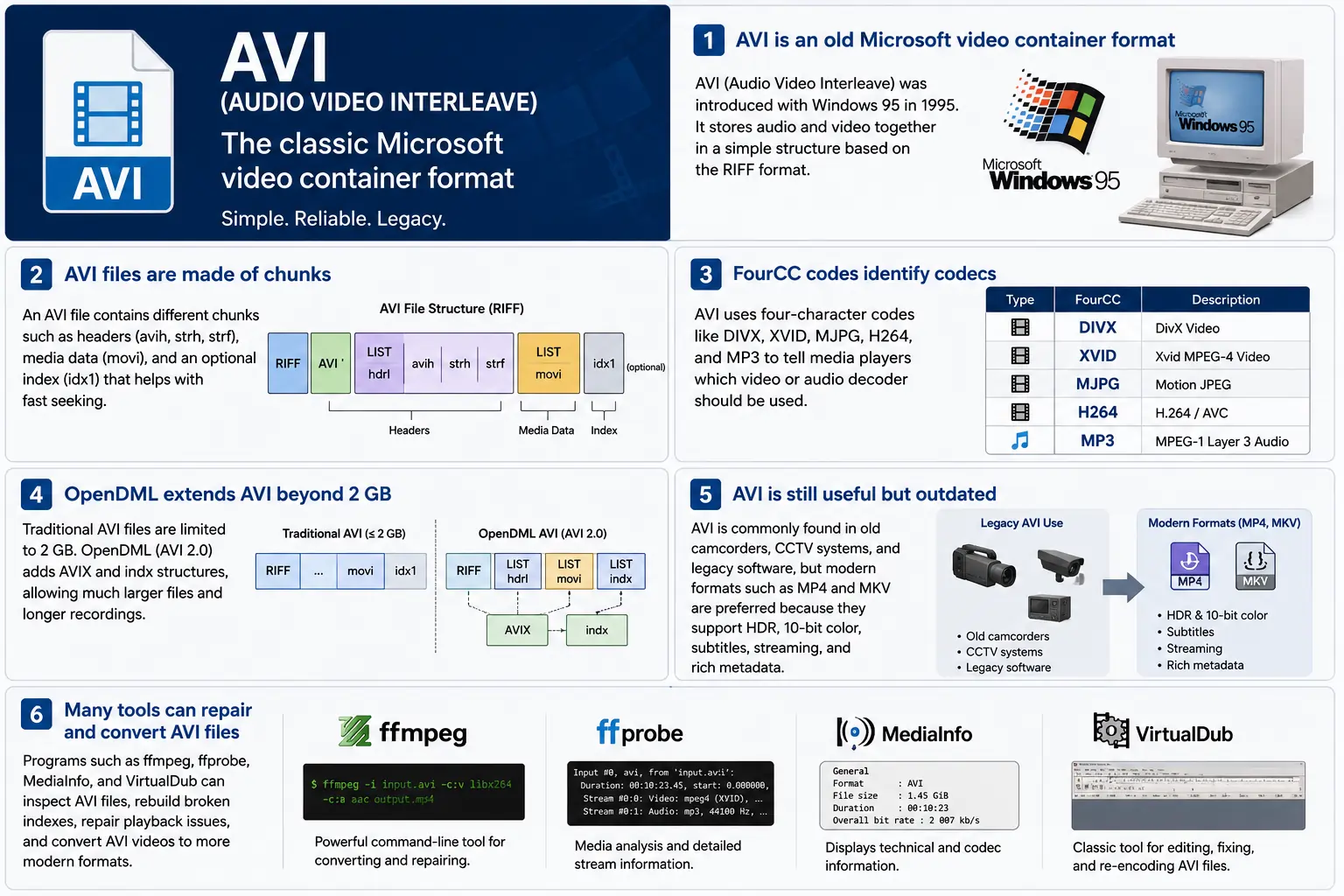
TL;DR – AVI (Audio Video Interleave) is Microsoft’s eerste “digitale video” container, geboren met Windows 95. Het is een eenvoudig RIFF‑gebaseerd bestand dat gecomprimeerde video‑ en audio‑chunks interleeft zodat een speler ze synchroon kan lezen. Het formaat wordt nog steeds begrepen door Windows Media Player en een reeks open‑source tools, maar het mist moderne functies zoals HDR, 10‑bit kleur en robuuste streaming‑metadata. Als je ooit legacy‑materiaal moet onderzoeken, begrijp dan de chunk‑indeling, FourCC‑codes en de OpenDML‑extensies die het 2 GB‑plafond verhogen – dat is de kern van AVI.
1. Wat is precies een AVI‑bestand?
- Volledige naam: Audio Video Interleave
- Eerste verschijning: Windows 95 (1995) – Microsoft’s antwoord op “digitale video” op de consumenten‑PC.
- Specificatie: Gebouwd op de RIFF (Resource Interchange File Format) specificatie uit 1991. RIFF is een generieke “chunk‑gebaseerde” container; AVI definieert simpelweg een set chunks die audio, video en indexgegevens bevatten.
- Bestandsextensie / MIME:
.avi–video/x-msvideo. - Primair doel: Zorg ervoor dat audio- en videostreams nauw verweven op de schijf blijven, zodat een eenvoudige afspeel‑lus een videoframe kan lezen, daarna het bijbehorende audiosample, zonder dure zoekacties.
- Legacy‑status: Nog steeds afspeelbaar in Windows Media Player, DirectShow, VLC en talloze andere spelers, maar het is geen “modern” container. Geen native HDR, 10‑bit, variabele bitrate of rijke metadata‑ondersteuning.
2. Binnen de doos – Hoe AVI werkt
Het RIFF‑chunk‑skelet
Een AVI‑bestand is gewoon een reeks chunks:
RIFF <size> "AVI "          ; file header
  LIST "hdrl"               ; header list
    avih ...                ; main AVI header (global info)
    LIST "strl"             ; stream list (one per stream)
      strh ...              ; stream header (type, codec, timing)
      strf ...              ; stream format (codec‑specific data)
  LIST "movi"               ; interleaved media data
    00dc <size> <video frame>
    01wb <size> <audio block>
    …
  idx1 ...                  ; optional index for fast seeking
- Chunk‑ID (4 bytes) – bijv.,
avih,strh,movi. - Chunk‑grootte (4 bytes) – lengte van de data die volgt (exclusief de ID‑ en grootte‑velden).
- Data – de feitelijke payload (headers, ruwe frames, enz.).
Omdat RIFF uitbreidbaar is, kun je nieuwe chunk‑typen toevoegen zonder oudere parsers te breken – een ontwerp dat AVI tientallen jaren levend hield.
FourCC – De Codec Fluisteraar
Vier‑karaktercodes (FourCC) zijn de lijm die een speler vertelt welke decoder te laden. Enkele veelvoorkomende die je in AVI‑bestanden zult zien:
| FourCC | Codec (ffmpeg) | Typisch gebruik |
|---|---|---|
DIVX | mpeg4 (DivX) | Vroege MPEG‑4 Deel 2 |
XVID | mpeg4 (Xvid) | Open‑source MPEG‑4 |
MJPG | mjpeg | Motion‑JPEG (digitale camcorders) |
H264 | h264 | H.264/AVC (zeldzaam maar mogelijk) |
MP3 | mp3 | MP3-audiostream |
PCM | pcm_s16le | Ongecomprimeerde PCM-audio |
De FourCC bevindt zich in de strh chunk (codec‑identificatie) en soms in het strf blok (pixelindeling, audio‑sample‑indeling).
Timing & Synchronisatie
AVI gebruikt een eenvoudig time‑base-systeem:
- Globale header (
avih):dwRate/dwScale→ frames per seconde. - Per‑stream header (
strh): zijn eigendwRate/dwScalevoor audio- of secundaire videostreams.
De speler vermenigvuldigt het framenummer met scale/rate om een presentatie‑tijdstempel (PTS) te berekenen. Als de schalen niet overeenkomen, zie je de klassieke “audio raakt uit sync”‑fout die legacy‑tools achtervolgt.
De movi Chunk – Waar de Media Leeft
Alle gecomprimeerde frames staan in de movi LIST. Elk frame wordt voorafgegaan door een chunk‑ID die aangeeft of het video (00dc) of audio (01wb) is. De ID codeert ook het stream‑nummer, dus een bestand met twee audiotracks zou 01wb en 02wb bevatten.
Omdat de gegevens al zijn geïnterleaved, kan een speler een videoframe lezen, vervolgens het volgende audioblok, en ze samen presenteren zonder ver vooruit te moeten zoeken. Dat deterministische schrijfpatroon maakte AVI populair voor vroege opname‑apparaten die lage‑latentie schijfschrijvingen nodig hadden.
Indexering (idx1) – Vooruitspoelen, Achteruitspoelen
De optionele idx1 chunk is een tabel met offsets en groottes voor elk frame in movi. Wanneer aanwezig, is zoeken een eenvoudige tabelopzoeking. Als deze ontbreekt, moeten spelers het bestand on‑the‑fly scannen – wat een merkbare “buffering”‑pauze kan veroorzaken bij grote bestanden.
OpenDML (AVI 2.0) – Doorbreken van de 2 GB Barrière
De oorspronkelijke RIFF-specificatie beperkt het grootteveld van een chunk tot een 32‑bit unsigned integer → 2 GB maximale bestandsgrootte. OpenDML (soms AVI 2.0 genoemd) introduceerde:
AVIXLISTs – extra “uitgebreide” RIFF‑secties die kunnen volgen op de eerste 2 GB.indxchunk – een 64‑bit index die dit aankan.- Extra header‑velden voor langere duur.
De meeste moderne tools (ffmpeg, VLC) schakelen automatisch over op OpenDML wanneer de output groter is dan 2 GB, maar veel oudere spelers blijven haperen bij AVIX‑chunks, waardoor je soms compatibiliteitshacks ziet die een lange opname opsplitsen in meerdere 2 GB AVI‑bestanden.
3. Waar leeft AVI in 2024?
| Trend | Wat dit betekent voor AVI |
|---|---|
| Overstap naar MP4/MKV/ProRes | Nieuwe producties geven de voorkeur aan containers die van nature HDR, 10‑bit, VBR en rijke metadata ondersteunen. AVI wordt zelden gekozen voor nieuwe inhoud. |
| Oude hardware | Oude CCTV‑camera’s, camcorders uit het begin van de jaren 2000 en sommige game‑engines produceren nog steeds AVI. Je moet die bestanden nog steeds in een moderne workflow verwerken. |
| Open‑source ondersteuning | ffmpeg, libav, VLC, HandBrake en GStreamer houden AVI‑parsers levend, maar ze hercoderen vaak naar MP4/MKV voor distributie. |
| OpenDML-heropleving | 4K‑bewakingsopnamen die dagenlang doorgaan, overschrijden snel 2 GB. OpenDML (AVIX) is nog steeds de oplossing, hoewel veel tools het verkeerd behandelen. |
| Beveiligingsverharding | Historische AVI‑parsers accepteerden misvormde chunk‑groottes, wat leidde tot CVE’s (bijv. CVE‑2020‑13144). Windows geeft nu de voorkeur aan Media Foundation, die veel legacy‑eigenaardigheden afwijst en ontwikkelaars richting veiligere pipelines duwt. |
| Container‑agnostische pipelines | Moderne mediakaders behandelen AVI als gewoon een ander source‑element. Zodra de data gedemuxed is naar ruwe buffers, wordt de container irrelevant voor verdere verwerking. |
Kort gezegd is AVI levend maar verouderend – het overleeft waar oude hardware of eenvoudige interleaved opslag vereist is, maar het is geen eerste keuze voor nieuwe projecten.
4. Hands‑On: Werken met AVI Vandaag
A. Een kijkje in een minimale header (hex)
52 49 46 46  00 00 00 00  41 56 49 20   ; "RIFF" + size + "AVI "
4C 49 53 54  20 00 00 00  68 64 72 6C   ; LIST "hdrl"
...
De RIFF‑magic (52 49 46 46) vertelt elke parser “dit is een RIFF‑bestand”. De volgende vier bytes zijn de totale bestandsgrootte (minus 8). De "AVI "‑identifier vergrendelt het bestand in de AVI‑familie.
B. Moderne MP4 → Legacy AVI omzetten
ffmpeg -i input.mp4 \
       -c:v mpeg4 -q

```bash
ffmpeg -i input.mp4 \\ -c:v mpeg4 -qscale:v 5 \\   # MPEG‑4 Part 2 (DivX/Xvid compatibel) -c:a mp3 -b:a 192k \\      # MP3-audio (de meeste AVI‑spelers begrijpen dit) -f avi output.avi
The command above forces MPEG‑4 Part 2 video (the codec most legacy AVI players recognize) and MP3 audio, then writes an AVI container. If you need OpenDML support for files larger than 2 GB, add the -movflags +faststart‑style flag that tells FFmpeg to use the extended AVIX chunks:
ffmpeg -i input.mp4 \\ -c:v mpeg4 -qscale:v 5 \\ -c:a mp3 -b:a 192k \\ -f avi -flags +global_header -movflags +faststart output.avi
Tip: Some older Windows Media Player versions still choke on the
AVIXextension. If you must stay under 2 GB, split the source into multiple AVIs using the-segment_timeand-f segmentmuxer.
5. Common Pitfalls & How to Fix Them
| Symptom | Likely Cause | Fix |
|---|---|---|
| Audio drifts out of sync after a few minutes | Mismatched dwRate/dwScale between avih and strh (or a VBR audio stream) | Re‑encode audio to a constant‑bitrate format (e.g., MP3 128 kbps) or use -vsync 2 in FFmpeg to force frame‑accurate timestamps. |
| “Cannot play this video” on Windows Media Player | Missing or corrupt idx1 index, or OpenDML (AVIX) chunks not recognized | Run ffmpeg -i broken.avi -c copy -map 0 -f avi repaired.avi to rebuild the index; or use aviindex (part of mplayer) to generate a fresh idx1. |
| File size capped at 2 GB despite long footage | Encoder used classic AVI (no OpenDML) | Add -use\_open\_dml 1 (FFmpeg) or -format avi2 (VirtualDub) to enable OpenDML extensions. |
| Green or corrupted frames | Incompatible FourCC (e.g., H.264 in an AVI without proper headers) | Stick to codecs known to work in AVI (mpeg4, msmpeg4v2, MJPG, XVID). If you must store H.264, use the h264 FourCC and ensure the strf chunk contains the SPS/PPS extradata. |
| Playback stalls on network streams | AVI’s lack of robust streaming metadata (no moov atom) | Wrap the AVI in a streaming protocol (e.g., RTSP) that handles byte‑range requests, or convert to MP4/MKV for smoother streaming. |
6. Debugging Tools You Should Keep Handy
| Tool | Platform | What It Does |
|---|---|---|
| ffprobe / ffmpeg | Cross‑platform | Dumps every chunk, FourCC, timestamps, and can rebuild indexes (-c copy). |
| MediaInfo | Windows/macOS/Linux | Human‑readable summary of streams, codecs, and container flags. |
| VirtualDub | Windows | Classic AVI editor; can rebuild headers, add OpenDML, and preview frame‑by‑frame. |
| GSpot (legacy) | Windows | Identifies obscure FourCCs and suggests appropriate codecs. |
| aviindex (part of MPlayer) | Linux/macOS | Generates a fresh idx1 chunk for broken files. |
| Hex editors (HxD, Bless) | Any | Directly inspect RIFF headers when you suspect malformed chunk sizes. |
A typical workflow when an AVI refuses to play:
- Inspect with
ffprobe -show_format -show_streams file.avi. - Check the index:
ffmpeg -i file.avi -c copy -f avi -y temp.avi(FFmpeg will rebuild it automatically). - Validate FourCCs:
mediainfo file.avi. If you see an unknown codec, consider re‑encoding that stream. - Repair with VirtualDub → “File → Re‑open as AVI (OpenDML)”. Save a fresh copy.
7. When (and When Not) to Use AVI
Good Use‑Cases
| Scenario | Why AVI Works |
|---|---|
| Legacy camcorder ingest | The device outputs native AVI; transcoding adds unnecessary quality loss. |
| Simple interleaved capture | Low‑latency write to disk without needing complex container features. |
| Compatibility with old Windows‑only software | Some industrial automation tools only understand AVI. |
| Archiving raw, uncompressed video | AVI can hold PCM audio and uncompressed RGB24 video without extra overhead. |
Bad Use‑Cases
| Scenario | Why AVI Fails |
|---|---|
| HDR or 10‑bit color | No standard way to store those pixel formats; you’d need a custom FourCC that most players ignore. |
| Variable‑bit‑rate streaming | Lack of a proper moov‑like atom makes adaptive bitrate impossible. |
| Rich metadata (chapters, subtitles, tags) | AVI’s chunk model doesn’t define standard containers for subtitles or extensive tags. |
| Cross‑platform mobile distribution | Modern mobile players expect MP4/MKV; AVI may not be hardware‑accelerated. |
If you’re starting a new project, treat AVI as a fallback for legacy pipelines, not a primary delivery format.
8. Future Outlook – Will AVI Ever Make a Comeback?
The short answer: unlikely. The industry has coalesced around ISO‑BMFF‑based containers (MP4, MOV, HEVC‑MP4, etc.) because they support:
- Extensible metadata (ISO‑UserData, UUID boxes).
- Fragmented streaming (moof/mdat) for adaptive bitrate.
- Native HDR/10‑bit/12‑bit video definitions.
AVI’s design, while elegant for its time, is fundamentally limited by its 32‑bit size fields and its reliance on external FourCC‑driven codecs. Even though OpenDML extended the size limit, it never gained widespread adoption beyond niche surveillance and archival tools.
That said, software preservation will keep AVI parsers alive for decades. Projects like FFmpeg, GStreamer, and VLC will continue to support the format, ensuring that the massive archive of 1990s‑2000s footage remains accessible. In a world where “digital archaeology” is becoming a real discipline, knowing how to read and repair AVI files is still a valuable skill.
9. Quick Reference Cheat‑Sheet
| Item | Command / Setting | Explanation |
|---|---|---|
| Create classic AVI | ffmpeg -i src -c:v mpeg4 -qscale:v 5 -c:a mp3 -b:a 192k -f avi out.avi | Simple, widely compatible. |
| Enable OpenDML | ffmpeg -i src -c:v mpeg4 -qscale:v 5 -c:a mp3 -b:a 192k -f avi -use_open_dml 1 out.avi | Allows >2 GB files. |
| Re‑index broken AVI | ffmpeg -i broken.avi -c copy -f avi repaired.avi | Rewrites idx1. |
| Split >2 GB into chunks | ffmpeg -i long.avi -c copy -map 0 -segment_time 1800 -f segment part_%03d.avi | 30‑minute segments stay under the limit. |
| Inspect header | ffprobe -show_format -show_streams file.avi | Dumps all RIFF chunks and stream info. |
| Add a subtitle track (non‑standard) | ffmpeg -i video.avi -i subs.srt -c copy -metadata:s:s:0 language=eng out.avi | Works only with players that read the txt stream; not universally supported. |
Keep this table bookmarked; it covers 80 % of everyday AVI tasks.
10. Best Practices for Archiving AVI Files
Even though AVI is a legacy container, many institutions still have petabytes of it sitting on tape or in cold‑storage. Treating those assets with a disciplined workflow will save you headaches down the line.
| Practice | Why It Matters | How to Implement |
|---|---|---|
| Validate on ingest | Corrupt headers or missing indexes can go unnoticed until playback. | Run ffprobe -v error -show_format -show_streams file.avi immediately after copying. Log any non‑zero exit codes. |
| Generate a checksum | Guarantees bit‑exact preservation across media migrations. | Use SHA‑256 (sha256sum file.avi > file.avi.sha256). Store the checksum alongside the file in your catalog. |
| Create a modern proxy | Most downstream workflows (editing, streaming) expect MP4/MKV. | Encode a low‑bitrate MP4 proxy (ffmpeg -i file.avi -c:v libx264 -crf 23 -c:a aac -b:a 128k proxy.mp4). Keep the proxy in the same directory with a clear naming convention (*_proxy.mp4). |
| Document FourCCs and codec versions | Some FourCCs map to multiple codec implementations (e.g., DIVX could be DivX 5, 6, or 7). | Extract the codec private data (ffprobe -show_private_data) and store it in a side‑car JSON file (file.avi.codec.json). |
| Migrate to OpenDML for large files | Files >2 GB will become unreadable on older players. | When transcoding, always pass -use_open_dml 1. If you’re only copying, use aviindex to rebuild an OpenDML‑compatible index. |
| Store metadata in a side‑car | AVI has no standard for extensive tags (e.g., creator, location). | Use XMP side‑car files (file.avi.xmp) or embed a small INFO LIST chunk manually if you need minimal in‑container metadata. |
| Regularly test playback | Bit‑rot can affect codecs as well as containers. | Schedule a quarterly job that runs a headless player (e.g., ffplay -autoexit -frames 10 file.avi) and reports any failures. |
By applying these steps at the moment of acquisition, you avoid costly “repair‑the‑archive” projects later.
11. Frequently Asked Questions (FAQ)
Q1: Can I store H.265/HEVC video inside an AVI file?
Short answer: Technically yes, if you supply the correct FourCC (HEVC or HVC1) and include the SPS/PPS NAL units in the strf chunk. In practice, very few players support it, and many will treat the stream as unknown. For reliable playback, stick to MPEG‑4 Part 2 or Motion‑JPEG.
Q2: Why does Windows Media Player sometimes show a black screen but still plays audio?
Explanation: The player has successfully opened the audio stream but failed to locate a usable video decoder for the FourCC. This can happen when the FourCC is custom or when the required codec isn’t installed. Installing a codec pack (e.g., K-Lite) or re‑encoding the video to a known FourCC resolves the issue.
Q3: Is there any way to embed subtitles directly into an AVI file?
Answer: AVI does not define a standard subtitle stream. Some tools cheat by adding a “txt” stream (FourCC txt ) that contains plain‑text subtitles, but only a handful of players (e.g., VirtualDub with a plugin) will render them. The recommended approach is to keep subtitles in a separate .srt or .ass file, or to re‑mux into a container that officially supports subtitles (MP4, MKV).
Q4: My video shows a “frame rate mismatch” warning in MediaInfo. What should I do?
Solution: Verify that the dwRate/dwScale values in both the global avih and per‑stream strh headers are consistent. If they differ, re‑mux with FFmpeg using -video_track_timescale to force a uniform time base:
ffmpeg -i broken.avi -c copy -video_track_timescale 1000 fixed.avi
Q5: Does AVI support multiple audio languages?
Yes, but with caveats. You can add several audio streams, each with its own strh/strf pair and a distinct stream number (01wb, 02wb, …). However, there is no standardized way to label the language; you must rely on external metadata (e.g., an accompanying .xml file) or embed a custom INFO chunk.
Q6: How can I extract raw frames from an AVI without re‑encoding?
Command:
ffmpeg -i source.avi -c:v copy -f image2 frame_%05d.bmp
Replace bmp with png or tiff if you prefer lossless image formats. The -c:v copy flag tells FFmpeg to dump the compressed frames as‑is; if the codec is MJPEG, the output will already be JPEG images.
Q7: Are there any security concerns when opening AVI files from untrusted sources?
Yes. Malformed chunk sizes can trigger buffer overflows in legacy parsers (e.g., older DirectShow filters). Always open unknown AVIs in a sandboxed environment or use a modern library like FFmpeg that performs strict bounds checking. Updating Windows Media Foundation and disabling legacy DirectShow filters further mitigates risk.
12. TL;DR Samenvatting (voor de ongeduldige)
- AVI = RIFF‑based, interleaved container introduced with Windows 95.
- FourCC tells the player which codec to use; common ones are
DIVX,XVID,MJPG,H264,MP3. - Timing is driven by
dwRate/dwScalein the global and stream headers. moviholds the actual media;idx1(optional) speeds up seeking.- OpenDML (
AVIX) lifts the 2 GB limit but isn’t universally supported. - Use cases today: legacy camcorder ingest, simple interleaved capture, archival of raw PCM video.
- Avoid for new projects: no HDR, 10‑bit, VBR, subtitles, or rich metadata.
- Toolbox:
ffprobe,ffmpeg, MediaInfo, VirtualDub, aviindex, hex editors. - Best practice: validate, checksum, generate modern proxies, and migrate large files to OpenDML.
13. Slotgedachten
AVI’s simplicity is both its strength and its Achilles’ heel. It gave early PC users a straightforward way to store synchronized audio‑video pairs, and that design philosophy—interleaved chunks, a clear header layout, and extensible FourCC identifiers—still influences modern containers. While the industry has moved on to more feature‑rich formats, the sheer volume of legacy footage means AVI will remain a “must‑know” for anyone working in video preservation, forensic analysis, or any field that must bridge the past with today’s workflows.
If you ever find yourself staring at a dusty .avi on a hard drive from the late‑90s, you now have the conceptual map, the command‑line recipes, and the troubleshooting checklist to bring that footage back to life—whether you choose to keep it in its original container or transcode it into a modern, HDR‑ready format.
Happy demuxing!