Last Updated: 23 Oct, 2026
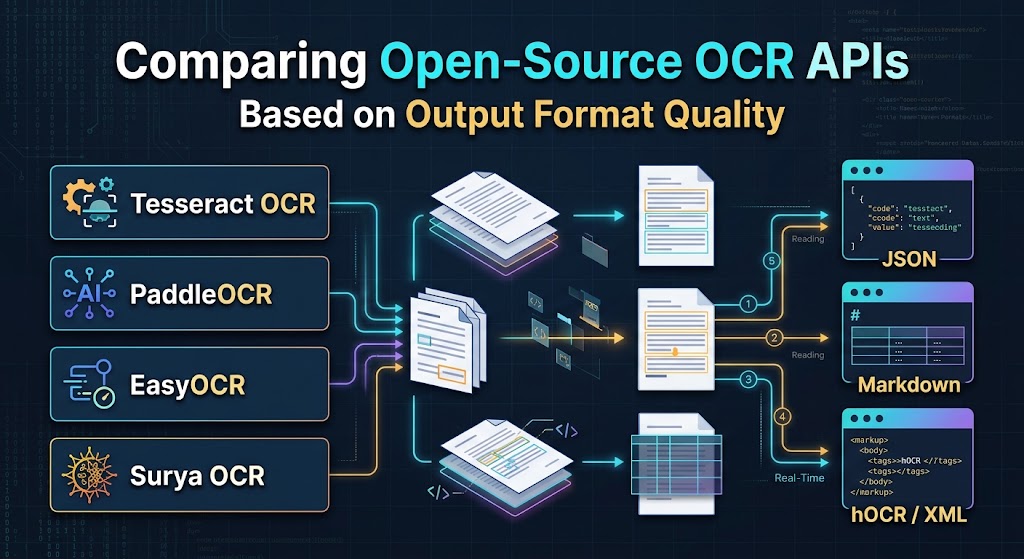
Comparing Open-Source OCR APIs Based on Output Format Quality
When engineers evaluate Optical Character Recognition (OCR) engines, character error rate (CER) and word error rate (WER) usually dominate the benchmarks. While recognition accuracy is essential, it solves only half the problem in production.
If you are parsing complex multi-column PDFs, extracting line items from receipts, or ingesting whitepapers into an LLM embedding pipeline, raw text dumps create massive engineering overhead. A string of characters without layout awareness, logical reading order, or coordinate data forces your team to write brittle heuristic parsers.
The true differentiator for modern document workflows is output format quality: how consistently and cleanly an engine delivers coordinates, reading order, structural hierarchy, and tabular data.
Below is an engineering-focused comparison of four leading open-source OCR engines—Tesseract, PaddleOCR, EasyOCR, and Surya OCR—evaluating how their outputs behave inside automated pipelines.
The Common Output Formats: What Engineers Actually Need
Every OCR API packages detected text differently. Understanding these formats helps determine how much post-processing your pipeline requires:
- Plain Text (
.txt): The simplest representation. It strips all positional metadata and collapses multi-column layouts into horizontal reads, which can scramble paragraphs. - Archival Standards (
hOCR,ALTO XML): XML/HTML-based formats standard in library archiving. They embed coordinates, font estimations, and confidence ratings inside DOM nodes. Extremely robust for document reconstruction, but bulky for microservices. - Structured JSON: The default choice for modern web backends. Delivers coordinate arrays (bounding boxes or polygons), confidence ratings, and hierarchical block/line/word structures.
- Markdown (
.md) / HTML Tables: The modern standard for Retrieval-Augmented Generation (RAG). Preserves semantic sections (headers, lists, bold text) and tabular matrices without requiring downstream spatial reconstruction.
1. Tesseract OCR
Maintained by Google, Tesseract remains the foundational workhorse of open-source OCR. Its architecture leans heavily on traditional page segmentation algorithms supplemented by an LSTM-based character engine.
Native Output Formats
- Primary Outputs: Plain text, hOCR (HTML), ALTO XML, TSV (Tab-Separated Values), and searchable PDF/A.
- Layout Awareness: Rule-based heuristics via Page Segmentation Modes (PSM).
Output Format Analysis
- Where It Excels: Tesseract’s
TSVandhOCRexports are standardized and predictable. A single TSV export returns structured columns forlevel,page_num,block_num,par_num,line_num,word_num,left,top,width,height, andconf. If you are converting paper archives into searchable PDFs or need strict adherence to institutional standards, Tesseract handles this natively without custom glue code. - Where It Falls Short: Tesseract has no native JSON API. Consuming its output in Python or Node.js requires parsing XML/TSV files or using wrappers like
pytesseract. Its layout engine also struggles with non-standard columnar flow, frequently mixing text from adjacent columns unless manual bounding crops are provided.
Tesseract Output Profile:
├── Plain Text: Clean for standard single-column pages
├── XML / hOCR: First-class, rock-solid support
├── JSON: Requires custom wrappers or TSV-to-JSON transforms
└── Markdown / Tables: Poor (requires custom reconstruction)
2. PaddleOCR
Backed by Baidu’s PaddlePaddle framework, PaddleOCR has gained widespread adoption due to its lightweight models, extensive multi-language coverage, and dedicated document analysis toolkit (PP-Structure).
Native Output Formats
- Primary Outputs: Python lists/dictionaries, raw JSON, visualization overlays, and structured HTML via PP-Structure.
- Layout Awareness: High (using deep learning models for layout parsing, orientation classification, and table recovery).
Output Format Analysis
- Where It Excels: Standard PaddleOCR returns 4-point polygon coordinates (
[[x1, y1], [x2, y2], [x3, y3], [x4, y4]]) alongside text strings and confidence scores. This handles skewed or curved text gracefully. However, its real strength lies in the PP-Structure suite, which detects layout regions (title, text, table, figure) and parses tables directly into valid HTML strings (<table>...</table>). This eliminates the need to manually compute cell spans from bounding boxes. - Where It Falls Short: The base API returns nested arrays that lack standard property keys across different versions. For structured applications, developers usually write an intermediate adapter to standardize field names (
bbox,text,confidence).
PaddleOCR Output Profile:
├── Plain Text: Clean across multiple orientations
├── XML / hOCR: Limited (JSON is the preferred interchange format)
├── JSON: Highly detailed with 4-point polygons
└── Markdown / Tables: Excellent (direct HTML table generation via PP-Structure)
3. EasyOCR
Built on PyTorch by JaidedAI, EasyOCR is built for rapid developer adoption. It packages CRAFT (Character Region Awareness for Text Detection) with deep learning recognition networks into a minimal API.
Native Output Formats
- Primary Outputs: Python lists containing tuples of coordinates, recognized strings, and confidence values.
- Layout Awareness: Low to moderate (text-line detection only; no document-level structural parsing).
Output Format Analysis
- Where It Excels: The simplicity of the return object is unmatched:Mapping this output to a standard REST response or serializing it directly to GeoJSON/custom schemas takes only a few lines of code. It performs reliably on natural scene text, license plates, and isolated document crops.
[ ( [[x1, y1], [x2, y2], [x3, y3], [x4, y4]], "Total Balance Due", 0.9842, ) ] - Where It Falls Short: EasyOCR does not perform holistic document layout analysis. It does not identify tables, heading hierarchies, or reading orders across complex columns. Using EasyOCR on a two-column academic paper often produces interweaved text snippets unless paired with an upstream layout detection model (such as YOLO or LayoutLM).
EasyOCR Output Profile:
├── Plain Text: Good for isolated text blocks
├── XML / hOCR: Not supported natively
├── JSON: Trivial to generate from Python tuples
└── Markdown / Tables: None (requires external layout pipelines)
4. Surya OCR
Surya is a modern deep-learning OCR framework designed specifically for complex document understanding and LLM ingest pipelines.
Native Output Formats
- Primary Outputs: Pydantic-modeled JSON structures, logical reading order indexes, layout bounding regions, and line detection polygons.
- Layout Awareness: Exceptionally high (deep-learning-based layout analysis and reading order sorting).
Output Format Analysis
- Where It Excels: Surya directly addresses the challenges of modern AI engineering. Instead of assuming documents read top-to-bottom, left-to-right, Surya deploys a dedicated model to predict reading order. It groups lines into logical semantic blocks, handles multi-column spans naturally, and outputs typed structures via Pydantic. This makes downstream ingestion into vector databases and Markdown converters direct and reliable.
- Where It Falls Short: As a newer, heavier PyTorch-based framework, Surya requires dedicated GPU compute to match the throughput of optimized C++ engines like Tesseract or quantized Paddle models. It does not target legacy archival standards like hOCR or ALTO.
Surya Output Profile:
├── Plain Text: Naturally ordered according to human reading flow
├── XML / hOCR: Not supported
├── JSON: Fully typed, modern Pydantic schemas
└── Markdown / Tables: Clean semantic blocks ideal for Markdown synthesis
Head-to-Head Comparison Matrix
| Capability / Format | Tesseract OCR | PaddleOCR (PP-Structure) | EasyOCR | Surya OCR |
|---|---|---|---|---|
| Native hOCR / ALTO XML | Native support | Third-party only | None | None |
| Bounding Box Geometry | Axis-aligned (x, y, w, h) | 4-point polygon | 4-point polygon | Polygon + Layout blocks |
| Table Parsing | Coordinate TSV only | HTML table strings | None | Cell coordinate grids |
| Reading Order Detection | Rule-based (breaks on multi-column) | ML layout analysis | Basic line grouping | Dedicated reading-order model |
| Direct JSON Schemas | Requires conversion | Python Dict / JSON | Python List / JSON | Typed Pydantic Models |
| Ideal Downstream Target | Archival PDFs, Legacy DMS | Form/Receipt Data, ERPs | Quick Scripts, Scene Text | LLM Ingest, RAG Architectures |
Pipeline Recommendations: Which Should You Choose?
- Choose Tesseract if your compliance requirements demand standardized
hOCR,ALTO XML, or searchable PDF/A deliverables for government or archival records. - Choose PaddleOCR if you are processing operational financial documents (invoices, receipts, tax forms) containing complex, borderless tables that must be converted to HTML or spreadsheets.
- Choose EasyOCR if you need a lightweight, Pythonic library to detect and extract text from natural images, street signs, or cropped UI elements without configuration hassle.
- Choose Surya OCR if you are feeding unstructured business reports, research papers, and technical guides into an LLM or vector search engine where logical reading order and clean structural boundaries are paramount.
Frequently Asked Questions (FAQ)
1. Which open-source OCR output format is easiest to feed into Large Language Models?
Surya OCR’s reading-order-aware JSON and PaddleOCR PP-Structure’s HTML tables provide the cleanest representations for LLM prompt contexts and RAG indexing.
2. Can Tesseract produce JSON responses natively without third-party tools?
No, Tesseract outputs text, TSV, PDF, and hOCR/ALTO XML natively; producing JSON requires converting its TSV or hOCR output using an intermediate parser.
3. How do 4-point polygon coordinates differ from axis-aligned bounding boxes?
Axis-aligned boxes use [x, y, width, height] assuming flat text, while 4-point polygons provide four coordinate pairs to accurately enclose rotated, skewed, or curved text lines.
4. Which engine outputs table structures directly into code rather than loose coordinates?
PaddleOCR’s PP-Structure module reconstructs detected table boundaries into complete HTML table tags (<table>, <tr>, <td>), avoiding custom spatial math.
5. Why does standard EasyOCR output struggle on multi-column scientific papers?
EasyOCR identifies text lines based on local proximity rather than global layout hierarchy, causing text from adjacent columns to intertwine unless bounded by an external layout engine.