Last Updated: 11 May, 2026
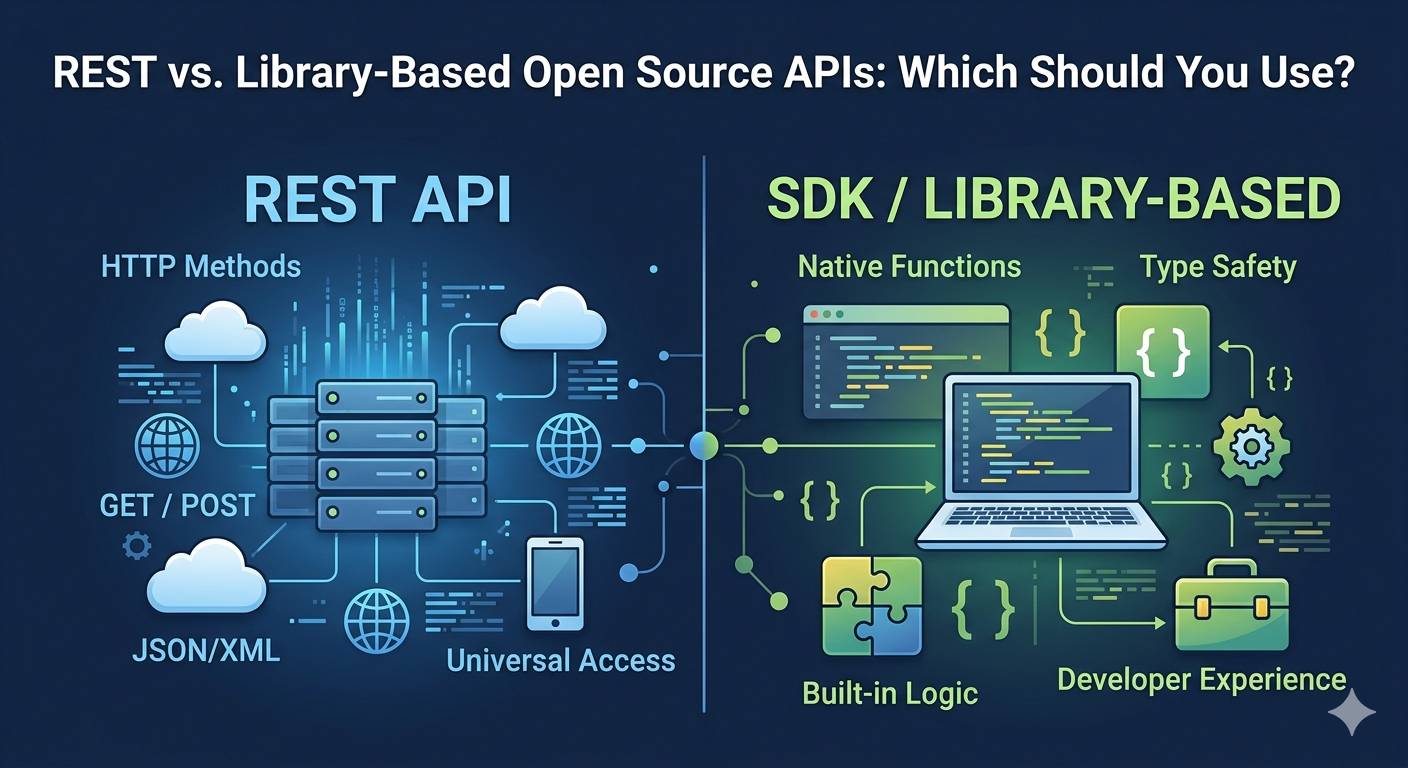
The landscape of software integration has shifted dramatically over the last decade. For developers and architects, the decision is no longer just about which service to use, but how to consume it. The debate typically boils down to two heavyweights: REST (Representational State Transfer) and Library-Based (SDK) Open Source APIs.
Choosing the wrong approach can lead to “integration debt,” where your codebase becomes difficult to maintain or scale. Here is a deep dive into the strengths, weaknesses, and ideal use cases for each.
1. REST APIs: The Universal Standard
REST is an architectural style that uses standard HTTP methods (GET, POST, PUT, DELETE) to interact with resources. It is language-agnostic, meaning it doesn’t care if your application is written in Python, Go, or Ruby.
The Benefits
- Interoperability: Since REST relies on HTTP, it works with almost any platform or device that can connect to the internet.
- Decoupling: The client and server evolve independently. You can update your backend logic without forcing clients to change their code, provided the endpoint structure remains the same.
- Caching: REST leverages standard HTTP caching mechanisms, which can significantly improve performance for read-heavy applications.
The Trade-offs
- Boilerplate Code: Developers often have to write manual code to handle HTTP requests, parse JSON/XML responses, and manage error codes.
- No Type Safety: Unless you use tools like OpenAPI/Swagger, REST responses are typically unstructured, leading to potential runtime errors if the API schema changes.
Leading REST APIs for Working with various file formats
2. Library-Based APIs: The Developer’s Shortcut
Library-based APIs, often provided as SDKs (Software Development Kits) or Open Source wrappers—abstract the complexity of the underlying API into native functions of a specific programming language.
The Benefits
- Native Experience: Instead of building a URL and parsing a response, you simply call a function: client.upload_file(). It feels like a natural part of your codebase.
- Type Safety and Intregration: In languages like C# (.NET) or Java, libraries provide IntelliSense and compile-time checks. This reduces bugs by ensuring you send the correct data types.
- Built-in Logic: Good libraries handle complex tasks like authentication (OAuth2), automatic retries, and pagination out of the box.
The Trade-offs
- Language Dependency: You are limited to the languages the maintainers support. If you use an obscure language, you may be forced back to REST.
- Maintenance Lag: If the core API adds a new feature, you must wait for the library maintainer to update the package before you can use it.
Leading Open Source APIs for Working with top file formats
3. Key Comparison: At a Glance
| Feature | REST API | Library-Based (SDK) |
|---|---|---|
| Setup Speed | Moderate (Manual boilerplate) | Fast (Plug and play) |
| Flexibility | High (Any language/tool) | Limited to supported languages |
| Learning Curve | Requires HTTP/Header knowledge | Requires library documentation |
| Performance | Overhead of HTTP calls | Optimized for the language |
| Updates | Immediate access to features | Dependent on library updates |
4. Which Should You Use?
Choose REST if:
- You are building a multi-platform ecosystem: If your service needs to be accessed by web, mobile, and IoT devices simultaneously.
- You need absolute control: If you want to optimize every header, timeout, and byte sent over the wire.
- You are using a cutting-edge language: If an official SDK doesn’t exist yet for your specific stack.
Choose Library-Based if:
- Development speed is a priority: You want to get to “Hello World” in minutes rather than hours.
- You want cleaner code: Native libraries keep your business logic focused and reduce the “noise” of network management code.
- You value stability: Libraries often include validated patterns for handling errors and rate limits that are hard to get right manually.
Conclusion
There is no “better” choice—only the right choice for your current project. REST APIs offer the ultimate freedom and longevity, making them the backbone of the modern web. However, Library-Based Open Source APIs provide a developer experience that is hard to beat for rapid scaling and type-safe integration.
If you are working with a well-supported open-source project, starting with their library is usually the fastest path to success. If you find the library is too restrictive or outdated, you can always “eject” and write direct REST calls when the need arises.
Free APIs for Working with Word Processing Files
FAQ
Q1: Can I use both a REST API and a library-based API in the same project?
A: Yes, the hybrid approach is actually recommended—use a library for high-frequency local logic and a REST API for remote data sync or proprietary services.
Q2: Is a library-based API always faster than a REST API?
A: Yes, because library APIs run directly in your machine’s memory with zero network latency, while REST APIs require HTTP round trips for every call.
Q3: What type of API should I use if my app needs to work offline?
A: Always choose a library-based API, since REST APIs require an active internet connection to send and receive HTTP requests.
Q4: Which API is better for building a public API for external developers?
A: REST APIs are the clear winner because they’re language-agnostic and work with any programming language that can send HTTP requests.
Q5: When should I avoid using a library-based API despite its speed advantages?
A: Avoid library-based APIs when you don’t want to ship your proprietary source code to users or when the computational logic (like a large AI model) is too big to install locally.